Insoles: How to Pick the Right Pair for Your Foot and Your Shoes
Arch support, cushioning, heel cups and trimming to fit — the buyer's guide to insoles for plantar fasciitis, flat feet, standing all day and work boots.
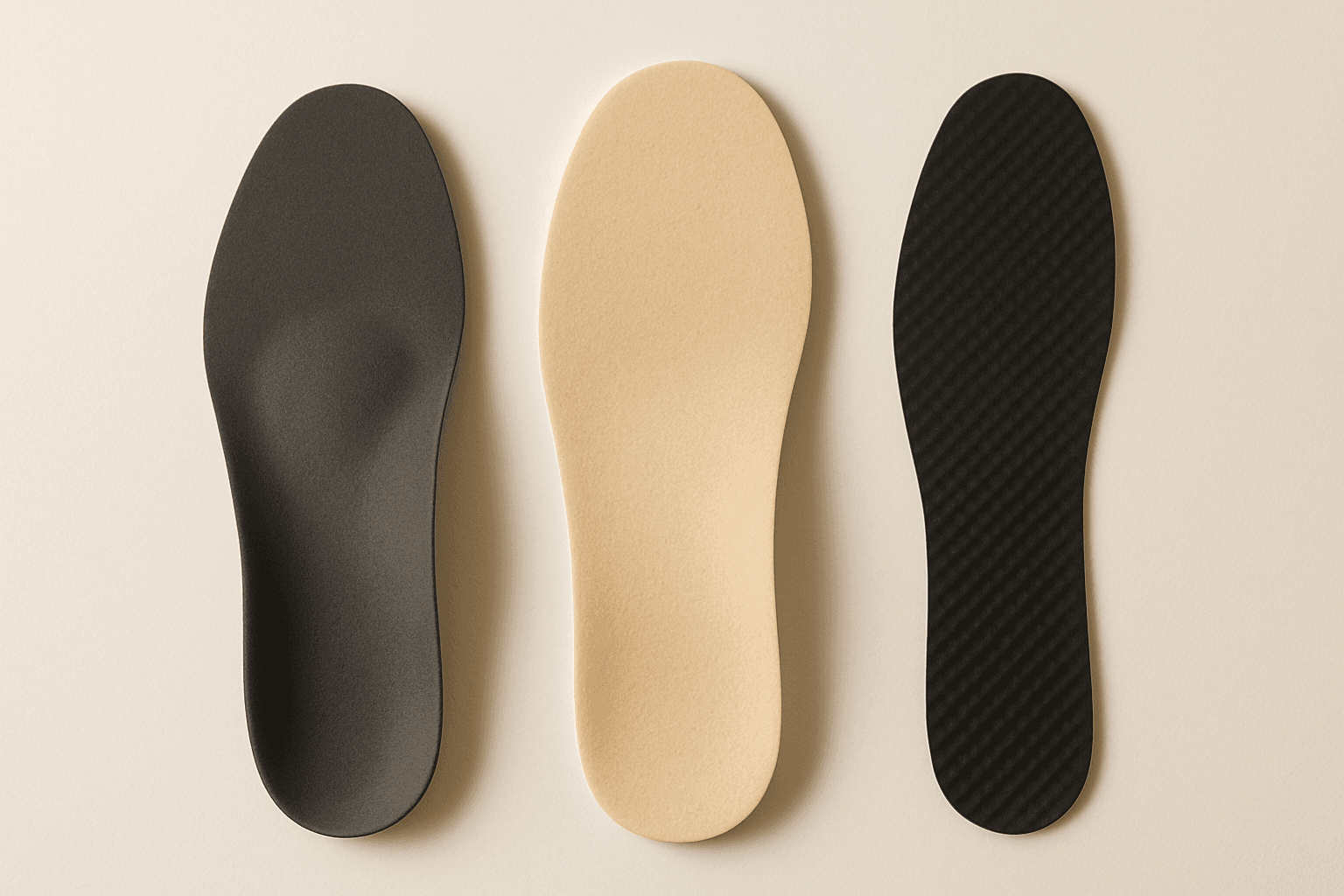
A good insole does two jobs: it supports the arch so the plantar fascia isn't overstretched with every step, and it cushions and cradles the heel so the fat pad absorbs less of the impact. Cheap flat foam does neither. Rigid custom orthotics do both but cost hundreds and take weeks to make. The over-the-counter insoles we review sit in the useful middle — enough support and cushioning to change how the foot loads, sold at a price you can try in a single pair without a specialist visit.
The parts that matter are unglamorous. A firm medial arch that does not collapse under body weight is the most important feature — soft, squishy arches feel great in the store and do essentially nothing after a mile of walking. A deep heel cup cradles the fat pad under the heel bone so it absorbs shock the way it was built to, instead of squirting out sideways under load. A dense but not brick-like foam or EVA base carries the two of them and takes the edge off hard floors. Everything else — gel dots, acupressure nodes, magnets, cooling top layers, brand-name marketing — is comfort or bonus. Support is what earns the score.
Different feet want different amounts of each. High arches transmit more shock into the heel and forefoot with less give in between, so the fat pad takes a beating; cushioning matters more than aggressive arch support, and our [supination insoles](/insoles/supination) walk-through covers the pick in more detail. Flat feet or feet that over-pronate stretch the fascia through more of its range with every step, so a firm arch that actually holds the shape does most of the work. Neutral feet with a specific complaint — morning heel pain, tired arches after a long shift, a bruised heel from a fall — usually do best with a balanced insole that has both a real arch and a deep heel cup. That is the profile of the pair we recommend first for most readers.
Job and shoe matter too. Concrete floors and eight-hour shifts in factory or warehouse boots ask for a firmer, more supportive insole that survives repeated wear; a floppy gel insert packs down in weeks. Work boots and heavy walking shoes have room for a full-length, thicker insole; slim dress shoes and low-volume runners often need a three-quarter length that supports the arch without crowding the toes. Runners who train hard on a specific complaint sometimes benefit from a carbon-plated insole for energy return, but for everyday comfort a well-shaped foam insole is enough. Height-increasing insoles are their own category — comfort-plus-lift, not a therapeutic tool.
How you use an insole matters as much as which one you buy. Ease it in over a week: a few hours the first two days, then a half day, then full days. Feet coming from flat drugstore inserts often report a strange first-day feeling — the arch is doing work the muscles were compensating for — that fades. Trim to your shoe using the old insole as a template and cut a little outside the line first so you can test the fit. Replace foam insoles every six to twelve months of daily wear; when the arch has packed down and the heel cup no longer feels distinct, the insole has done its life's work.
Insoles are a comfort and support product, not a medical treatment. They can make a stretching routine, a supportive shoe and a sensible day on your feet actually stick, and for the two most common heel pain patterns — plantar fasciitis under the heel and fat pad irritation across the pad — they are the highest-leverage upgrade you can make to the shoes you already own. They will not fix a stress fracture, a nerve entrapment or an inflammatory condition, and pain that has not budged after a month of honest home care deserves an in-person exam by a doctor or podiatrist.
Use this hub as a buyer's guide. Start with the buyer categories that match your problem — [plantar fasciitis](/insoles/plantar-fasciitis), [flat feet](/insoles/flat-feet), [standing all day](/insoles/standing-all-day), [work boots](/insoles/work-boots) — then dip into the format posts ([heel cups vs insoles](/insoles/heel-cups-vs-insoles), [gel vs silicone heel cups](/insoles/gel-vs-silicone-heel-cups), [how to use heel cups](/insoles/how-to-use-heel-cups)) to understand what you are actually picking between. Two specialty categories sit apart from the therapeutic mainline: [carbon fiber insoles](/insoles/carbon-fiber-insoles) are a narrow tool for big-toe and ball-of-foot problems, and [height-increasing insoles](/insoles/height-increasing-insoles) are a cosmetic product with a real biomechanical footprint of their own. Every recommendation links to a full review of the product we would buy first.
In this guide
- Insoles for High Arches: What Supports a Rigid Foot and What Only Looks Supportive
- Orthotics vs Insoles: What the Words Actually Mean and When You Need Each
- Insoles for Plantar Fasciitis: The Features That Actually Change Morning Pain
- Carbon Fiber Insoles: What the Stiff Plate Actually Does and When It Helps
- Height-Increasing Insoles: What They Are, How to Wear Them Without Wrecking Your Feet
- Supination Insoles: What Actually Supports a Foot That Rolls Outward
- Gel vs Silicone Heel Cups: Which One Is Actually Better for Your Heel?
- Best Insoles for Work Boots: What Actually Survives a Season on Concrete
- Insoles for Flat Feet: What Actually Supports a Fallen Arch Through a Long Day
- Best Insoles for Standing All Day: What Actually Survives a 12-Hour Shift
- How to Use Heel Cups: Fit, Placement and Break-In So They Actually Help
- Heel Cups vs Insoles: Which One Do You Actually Need for Your Heel Pain?
- Best insoles for plantar fasciitis coming soon
- Insoles for flat feet coming soon
- Insoles for standing all day coming soon
- Insoles for work boots coming soon
- Supination insoles coming soon
- Carbon fiber insoles coming soon
- Height increasing insoles coming soon
- Heel cups vs insoles: which one do you actually need? coming soon
- How to use heel cups coming soon
- Gel vs silicone heel cups coming soon
Our picks
Written and reviewed by the Heelcups.com Team. General information, not medical advice — see our medical disclaimer. Reader-supported: we may earn a commission when you buy through our links.