PLANTAR FASCIITIS IN BOTH FEET
Plantar Fasciitis in Both Feet: What Bilateral Heel Pain Means and How to Manage It
Having plantar fasciitis in both feet at once is less rare than most readers think, and it changes the daily plan in specific ways. Here is what bilateral heel pain usually points to, when it is a flag for something else, and how to run the stretch, shoe and insole routine when you have no good foot to lean on.
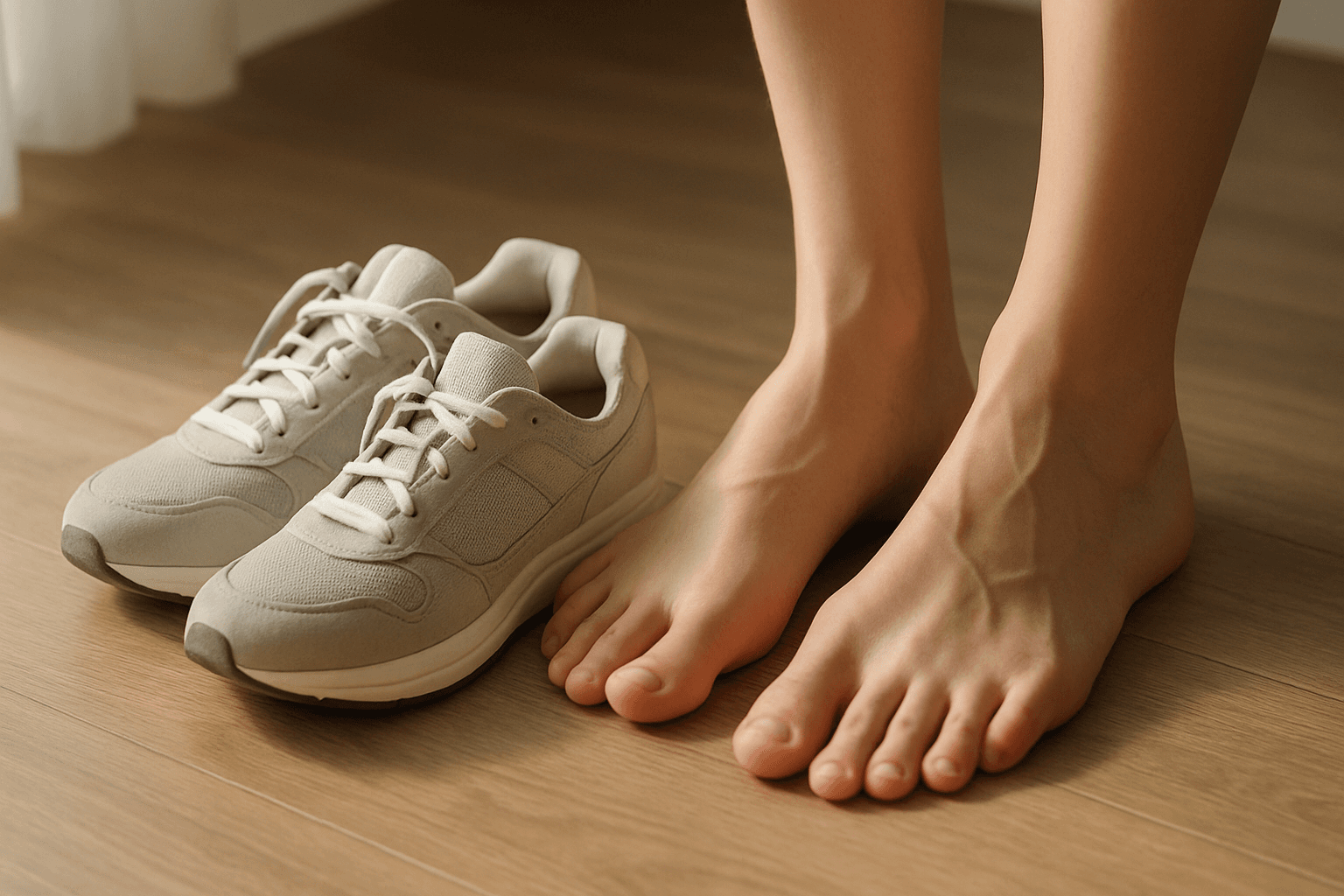
Plantar fasciitis in one foot is the version of the condition people are prepared for — a stabbing morning stab under one heel, a limp in the first steps, a slow improvement over weeks with a stretch routine and a decent insole. Plantar fasciitis in both feet at once is less common, less talked about, and a different experience to manage because there is no comfortable foot to pivot onto. The morning floor becomes something you brace for with both legs; the limp becomes a shuffle; the usual advice to "shift weight to the other side" becomes meaningless because the other side hurts too.
Bilateral plantar fasciitis is also diagnostically different. Most pure overuse cases are one-sided — a specific running shoe wore out, a specific mileage ramp overloaded one foot, a specific job landed on the dominant leg. When both feet are flaring in the same pattern at the same time, the honest first move is to think not just about the fascia but about what both feet have in common: a job on hard floors, a weight change, a pregnancy, a flat-shoe summer, a new fitness routine, a flat foot structure that is now showing its hand, or in a small number of cases an inflammatory arthritis that has nothing to do with mechanical overuse. This page is the walk-through of how to tell those apart, how to run the daily routine when both feet need the attention, and when the picture deserves a specialist eye rather than another insole.
Nothing here is medical advice. Bilateral heel pain that has lasted more than four weeks, has come on without a clear mechanical trigger, or is paired with heel pain plus other joint pain anywhere in the body deserves a prompt in-person exam by a doctor, podiatrist or rheumatologist. Every recommendation on this plantar fasciitis hub is written for relief, comfort and support — nothing on this site cures plantar fasciitis.
How common is bilateral plantar fasciitis, really?
Published figures put bilateral plantar fasciitis somewhere between a quarter and a third of adult cases, with most of the rest one-sided. The number is a wide range because studies draw on different populations — a sports medicine clinic sees more one-sided running-overuse cases, a general podiatry practice sees more bilateral standing-job cases — but the practical read is that bilateral is far from rare. If both your heels are stabbing in the morning in the same way, you are in a well-populated group of readers, not an unusual edge case.
The honest second number is that many "one-sided" cases are actually bilateral under the surface. The fascia on the better side is often mildly irritated but not loud enough to notice yet, especially when the louder side has you avoiding full weight on it. Clinicians who run an ultrasound often find thickening on both sides of patients who report pain on only one, which is one reason the daily routine advice is almost always symmetrical — stretch both calves, support both arches, cushion both heels — even when only one side is complaining.
What this means for the reader whose both feet are flaring is that nothing is wrong with you in a special way. Bilateral is a known pattern of the same condition, with the same drivers, the same daily plan, and roughly the same timeline. The specific daily moves have to be adjusted for the fact that you cannot favor one side, and that is the real story of this page.
What bilateral pain usually points to
The highest-probability driver of a bilateral flare, by a wide margin, is time on your feet on hard surfaces. A new job that puts you on concrete all day, a trade show season, a travel-heavy stretch where you were on airport floors for a week, a move into retail or healthcare, a summer of flat canvas shoes — all of these load both feet similarly and all of them show up as the same morning stab in both heels within a few weeks. The daily plan for this driver is unglamorous but reliable: a supportive insole in every shoe you wear, a supportive house shoe for the hours at home, a daily plantar fasciitis stretches routine, and a short-term cut in whatever activity tipped the tissue over on both sides.
The second-most common driver is a weight change or a pregnancy. A gain of fifteen or twenty pounds over a few months increases the load the fascia tolerates with every step by a proportional amount, and both feet feel it. Pregnancy adds a hormonal softening of the ligaments that compounds the loading change, which is covered in detail in our walk-through on plantar fasciitis in pregnancy. In both cases, insoles and supportive shoes do a disproportionate amount of the comfort work while the loading side settles over the following weeks and months.
The third is foot structure that has been quietly flat for years and finally met the wrong combination of job, weight and shoe. Flat feet are not a cause of plantar fasciitis on their own — plenty of flat-footed people never have an issue — but a low-arched foot in an unsupportive shoe on a hard floor is a reliable recipe for a bilateral flare, because the fascia is overlengthening on both sides with every step. Our walk-through on insoles for flat feet covers the specific shape of insole that helps most, and most readers in this category notice meaningful comfort within one to two weeks of adding real arch support to the shoes they already own.
When bilateral heel pain is a flag for something else
A small but important group of bilateral heel pain cases is not mechanical. Spondyloarthropathies — a family of inflammatory arthritides that includes ankylosing spondylitis, psoriatic arthritis and reactive arthritis — can produce enthesitis, which is inflammation where tendons and fascia attach to bone. The plantar fascia at the heel is one of the classic enthesitis sites, and bilateral heel pain plus any of the following is a reason to ask about rheumatology rather than another insole: low-back stiffness that is worst in the morning and improves with movement, pain and stiffness in other joints (knees, Achilles tendons, elbows), psoriasis skin plaques anywhere on the body, eye inflammation, or a family history of psoriatic or ankylosing arthritis. A GP or primary care doctor is the right first stop; they can order the baseline blood work (ESR, CRP, sometimes HLA-B27) that either rules the picture in or rules it out.
A second non-mechanical pattern is systemic inflammatory disease that has not declared itself yet. Lupus, rheumatoid arthritis and inflammatory bowel disease (which has an associated arthritis) can all produce heel pain, usually alongside other symptoms rather than in isolation. If bilateral heel pain is paired with persistent fatigue, unexplained weight loss, rashes, mouth or genital ulcers, or new joint pain anywhere else, the honest next step is a primary care appointment, not another aisle product.
The third pattern is referred pain or nerve-flavored heel pain that only looks like fascia. Tarsal tunnel syndrome can be bilateral, especially in flat-footed readers or readers whose job keeps the ankles compressed; nerve entrapment at the lumbar spine can produce symmetric heel pain by starving the sensory nerves that reach the sole; metabolic neuropathy from diabetes or B12 deficiency can produce a burning or stabbing in both heels that is read as plantar fasciitis for months before the underlying picture gets caught. Any heel pain that comes with tingling, numbness, pins and needles, or a sensation of walking on something that is not there is in the nerve family and deserves a clinician.
The daily plan when both feet are flaring
The core routine for bilateral plantar fasciitis is the same as for one-sided — a daily stretch sequence, a supportive insole in every shoe, a cut in whatever activity tipped the tissue over, cushioning for the morning floor — but it has to be run symmetrically because there is no comfortable side to lean on. The morning move that most readers find most useful is a seated calf and arch stretch from the edge of the bed before any weight goes onto the floor. Thirty seconds a side, three rounds each, done with a towel looped under the ball of each foot, changes the character of the first-step pain more than almost any other single intervention, and it costs ninety seconds.
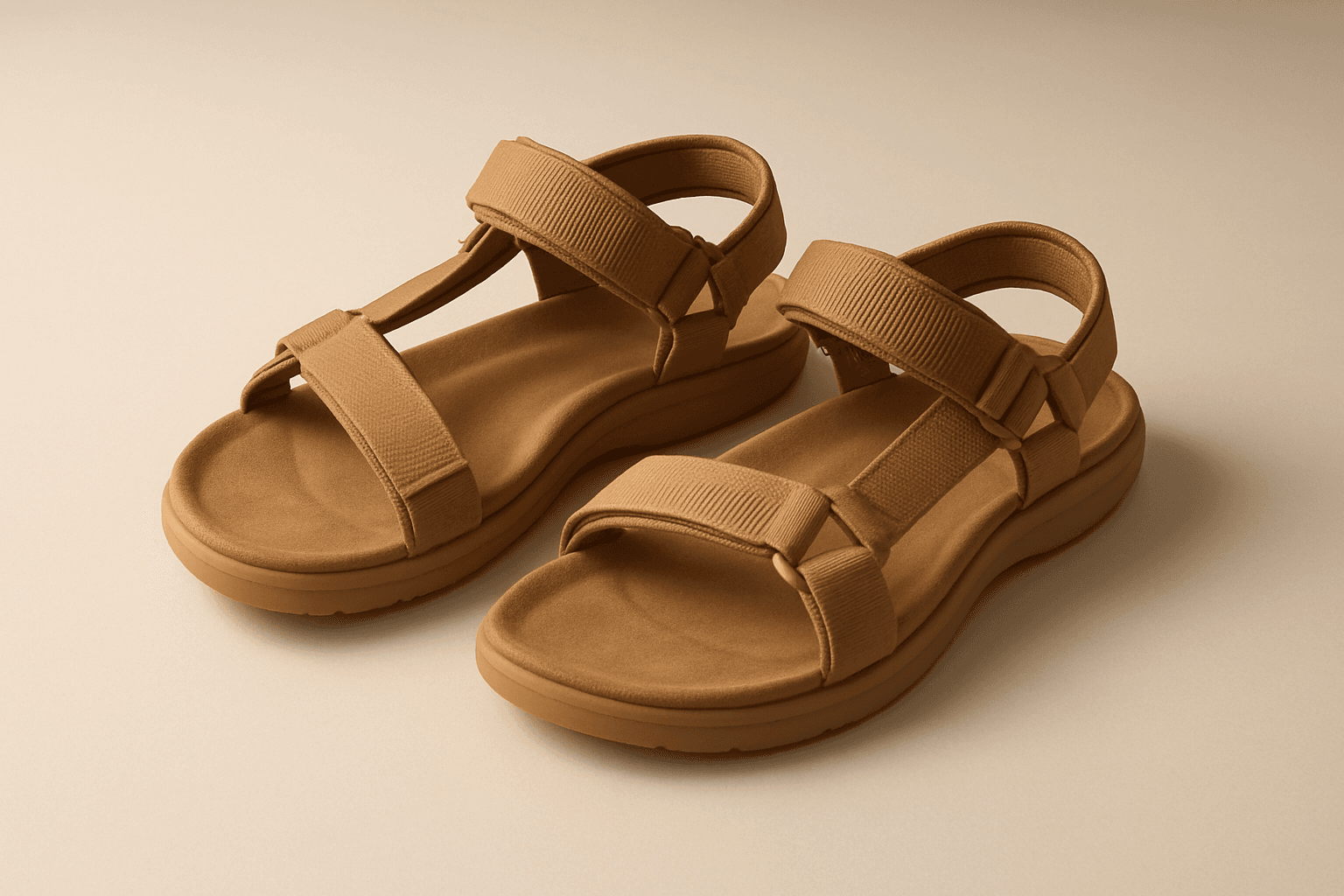
The second move is a supportive house shoe or recovery sandal, worn from the moment feet hit the floor until socks and real shoes go on, and worn again in the evening when work shoes come off. Bare feet on tile at the kitchen sink in the morning is the specific pattern that keeps a bilateral flare from calming down, and it is almost always the hidden driver when a reader reports no progress despite doing everything else right. Our walk-through on doctor-recommended shoes for plantar fasciitis covers the broader shoe choice.
The third move is the between-shoes insole, and here the answer is boring but true: you want the same supportive insole in both work shoes, both running shoes, both daily sneakers, and anything else you wear for more than an hour. Readers often buy one pair of insoles and swap them between shoes, which both halves the useful dose and tends to produce a one-sided-feeling result because the pair happened to be in the better shoe that day. Our Akusoli insoles review covers the pair we would install, and the honest advice for bilateral readers is to buy enough pairs to leave a set in every shoe you rotate through the week.
Working, standing and training with bilateral plantar fasciitis
Most readers with bilateral plantar fasciitis cannot take two weeks off their feet, and the honest advice is not to try. Short seated breaks spread through a shift do more good than a single long rest at the end; a sixty-second seated calf stretch every two hours, done at a desk or in a break room, keeps the calves from locking down between the daily morning and evening sessions. Where seated breaks are not possible, a quiet five-second heel raise set every twenty or thirty minutes — up on toes, hold three seconds, down — recruits the calf complex and takes a small share of the load off the fascia for the next few minutes.
An anti-fatigue mat at a standing workstation is a change that most readers notice within a few days. For warehouse, retail and healthcare readers, a supportive insole in the work shoe plus an anti-fatigue mat at the primary standing spot is the comfort pairing that makes a twelve-hour shift tolerable while the fascia settles. Ice at the end of the day — a frozen water bottle rolled slowly under each arch for three to five minutes a side — settles the inflammatory signal that accumulated through the shift.
Riders can apply the same logic on the bike; see cycling with plantar fasciitis. Running or walking training with bilateral plantar fasciitis follows the same traffic-light rule we lay out in our running with plantar fasciitis walk-through, with one adjustment: the rule applies to the worse foot, not the better one. If the worse heel is in the yellow or red zone, the planned session gets the yellow or red treatment, even if the other heel is quieter. Readers who try to split the difference (yellow routine because "on average" the pain is yellow) tend to overload the worse side and get a bilateral flare that lasts longer than it had to.
The honest timeline and when it is time to escalate
Bilateral plantar fasciitis settles on roughly the same timeline as one-sided — most cases are meaningfully better in four to eight weeks of honest routine, and the morning stab is usually under a three-out-of-ten by two months. The specific thing that tends to be longer for bilateral readers is the plateau phase, the stretch of weeks when the morning pain is clearly better than the start but not yet quiet. That phase can last a month or two before the final step down. Readers who stay patient through it, keeping the daily routine and the supportive shoes on both feet, almost always see the plateau break; readers who drop the routine the moment the pain is tolerable almost always flare again within a month.
The escalation ladder is the same as for one-sided plantar fasciitis, with one practical difference: because there is no comfortable side to lean on, formal physical therapy tends to pay off sooner, often by six to eight weeks of honest home care without clear progress rather than the three or four months we usually name for one-sided cases. A short course of PT (eight to twelve sessions) can teach the specific loading progression and the manual therapy that pushes a bilateral case over the plateau. Night splints are useful when morning stiffness is the leading complaint; the honest trade-off is comfort during sleep.
Three patterns are reasons to escalate sooner. The first is bilateral heel pain plus any of the inflammatory signals above (back stiffness, other joint pain, skin changes) — that is a rheumatology conversation, not a plantar fasciitis one. The second is bilateral pain that is clearly worse at rest, worse at night, or paired with numbness, pins and needles, or color change — nerve or vascular causes that need a clinician. The third is bilateral pain that has not meaningfully budged in three months of honest home care and PT — that is the stage where imaging (ultrasound, sometimes MRI) and a specialist conversation about shockwave therapy, a corticosteroid injection or further evaluation makes sense. Persistent heel pain in both feet deserves an in-person exam by a doctor or podiatrist; the goal here is comfort and support while the right picture gets the right eyes on it.
Support both feet, not one at a time
A trim-to-fit insole with a firm medial arch and deep heel cup. For bilateral readers, the honest advice is a pair in every shoe you rotate through — the between-shoes support is where most of the comfort comes from.
Support both feet, not one at a time →Frequently asked questions
Is it common to have plantar fasciitis in both feet at the same time?
Yes — somewhere between a quarter and a third of adult cases are bilateral by the time they are diagnosed, with the rest one-sided. Many cases that look one-sided on the surface turn out to be mildly bilateral under ultrasound; the better side is often lightly irritated but not loud enough to notice. Bilateral is a well-populated pattern of the same condition, not a special or more serious version, as long as the usual overuse and shoe and surface drivers fit. The outlier version — bilateral heel pain with no clear mechanical trigger, or paired with other joint symptoms — is a smaller category that deserves a rheumatology look.
Why would both my feet get plantar fasciitis at once?
The three most common drivers are time on your feet on hard surfaces (a new standing job, a trade show season, a travel-heavy stretch), a weight change or pregnancy that increases the daily load the fascia tolerates, and a flat or low-arched foot structure that finally met the wrong combination of shoe and surface. Any of these affect both feet symmetrically and show up as the same morning stab in both heels within a few weeks. A smaller but important group of bilateral cases traces to inflammatory arthritis (psoriatic arthritis, ankylosing spondylitis, reactive arthritis) rather than mechanical overuse — that is worth asking a primary care doctor about if you have back stiffness, other joint pain or psoriasis along with the heel pain.
Should I worry if both heels hurt in exactly the same way?
Not automatically — pure overuse bilateral plantar fasciitis is a known pattern and responds to the same daily routine as the one-sided version. The specific reasons to escalate sooner are bilateral heel pain that came on without a clear mechanical trigger, bilateral pain paired with low-back stiffness that is worst in the morning, bilateral pain plus other joint pain or psoriasis, bilateral pain that is worse at rest or wakes you at night, and bilateral pain plus any numbness, pins and needles, or color change. Any of those is a reason to ask a primary care doctor or podiatrist about the picture, often with an eye to rheumatology or a nerve evaluation rather than just another insole.
Do I need two pairs of insoles if both feet have plantar fasciitis?
You need enough pairs that every shoe you spend meaningful time in has a supportive insole in it. Readers often buy one pair and swap it between shoes, which effectively halves the dose and often produces a one-sided-feeling result because the pair is only in the better shoe that day. The honest advice for bilateral readers is to put a pair in each shoe you rotate through the week — the work shoe, the daily sneaker, the house shoe or recovery sandal — so the fascia on both sides is being supported continuously. The marginal cost is small; the comfort payoff is large.
Can I still work on my feet with plantar fasciitis in both feet?
Most readers can, with the right setup. Supportive insoles in the work shoe on both feet, a supportive house shoe or recovery sandal for the hours at home, a daily morning stretch sequence before weight goes onto the floor, short seated calf stretches every two hours during the shift, and an ice bottle under each arch for three to five minutes a side at the end of the day — this is the comfort package that makes a long day tolerable while the fascia settles. An anti-fatigue mat at a standing workstation is a cheap addition that most readers notice within a few days. If the pain is red-light level in both feet or if the shift is leaving the next morning sharper, that is a conversation with occupational health or a physical therapist about short-term duty modification.
How long does bilateral plantar fasciitis take to improve?
The honest timeline is similar to one-sided — most cases are meaningfully better in four to eight weeks of honest routine, and the morning stab is usually under a three out of ten by two months. The specific thing that tends to be longer for bilateral readers is the plateau phase, the stretch of weeks when the pain is clearly better than the start but not yet quiet; that phase can last an extra month or two before the final step down. Readers who stay patient through it almost always see the plateau break. If three months of honest home care has not moved the needle at all, that is the stage where formal physical therapy, imaging and a specialist conversation about further options make sense.
HeelCups is reader-supported. When you buy through links on our site we may earn an affiliate commission, at no extra cost to you. This article is general information about foot comfort and is not medical advice — see our medical disclaimer.