TARSAL TUNNEL
Tarsal Tunnel Syndrome: The Nerve Pain That Looks Like Plantar Fasciitis — And How to Tell Them Apart
Tarsal tunnel syndrome is a pinched nerve on the inside of the ankle that produces burning, tingling and shooting heel pain. It is less common than plantar fasciitis, often misdiagnosed as it, and the daily plan is different enough that the right read matters.
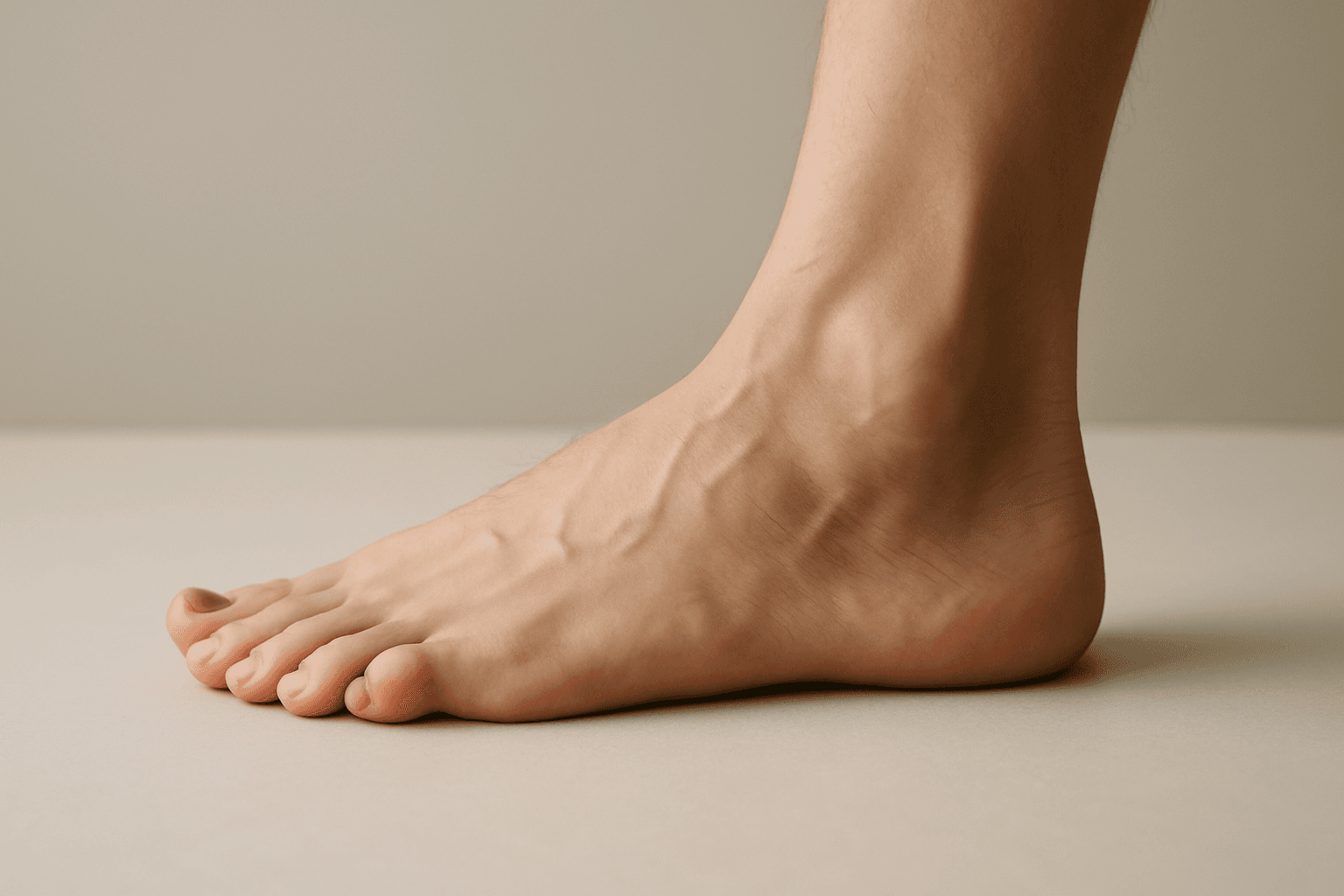
Tarsal tunnel syndrome is a pinched-nerve problem on the inside of the ankle, in the same way carpal tunnel syndrome is a pinched-nerve problem at the inside of the wrist. The posterior tibial nerve passes through a narrow bony canal behind the inner ankle bone (the medial malleolus), under a thick ligament, and into the sole of the foot where it fans out into the branches that supply sensation to the heel, the arch and the toes. When the tunnel is crowded — by swelling, by a ganglion cyst, by a bony outgrowth, by a flat-foot alignment that stretches the nerve, by a cuff that stays on too tight after an injury — the nerve is irritated and produces burning, tingling, electric-shock pain and sometimes a dull ache in the heel and the arch. It is far less common than plantar fasciitis, and far more often misdiagnosed as it. For a wider look at pain on the inner edge of the heel, see inside of heel pain.
This page covers how to tell tarsal tunnel syndrome apart from the plantar fasciitis it often mimics, what the daily routine looks like when the pain is actually nerve-driven rather than fascia-driven, and when the picture belongs with a clinician for imaging, a nerve conduction study, or a decompression conversation. Our why does my heel hurt walk-through covers the fuller map of heel pain differentials; tarsal tunnel syndrome is one of the less common but more treatable entries on that map, and a correct read of what you actually have changes the plan.
Nothing on this page is medical advice. Nerve pain in the foot deserves an in-person exam by a podiatrist, an orthopedist with foot-and-ankle experience, or a neurologist — the differential is wider than a self-care page can safely cover, and a few of the other causes (lumbar radiculopathy, diabetic neuropathy, nerve injury from a specific trauma) have very different treatment pathways. Every recommendation on this hub is written for comfort, support and relief; nothing on this site is a treatment or a cure for a nerve or musculoskeletal condition.
What tarsal tunnel syndrome actually is
The tarsal tunnel is a narrow fibro-osseous canal on the inside of the ankle, bounded by the medial malleolus (the knob of bone on the inside of your ankle), the talus and calcaneus below, and the flexor retinaculum — a thick ligament stretching from the ankle bone down and back to the heel. Running through the tunnel are the posterior tibial artery and vein, the tendons of the posterior tibial, flexor digitorum longus and flexor hallucis longus muscles, and the posterior tibial nerve. The nerve splits inside or just past the tunnel into the medial plantar nerve (sensation to the inner sole and the first three toes), the lateral plantar nerve (sensation to the outer sole and the last two toes), and the medial calcaneal nerve (sensation to the inner and lower heel).
Tarsal tunnel syndrome is any condition that crowds that tunnel enough to irritate the nerve as it passes through. The most common identifiable causes are a ganglion cyst sitting in the tunnel, a varicose vein stretching the space, a bony outgrowth from an old ankle injury, swelling from a sprained ankle that lingers after the sprain itself has resolved, a flat-foot alignment that stretches the nerve as the hindfoot collapses, and the swelling of pregnancy. In roughly a third of cases no specific cause is found on imaging — the tunnel is simply tight for that patient, often in the setting of a modest flat-foot alignment that produces chronic traction on the nerve over years.
The character of the pain is the single most useful clue that distinguishes it from plantar fasciitis. Plantar fasciitis pain is mechanical and sharp — a stab under the heel that is worst with the first steps in the morning and after sitting, and that eases as you walk. Tarsal tunnel pain is neurologic — a burning, tingling, electric-shock sensation that often radiates into the arch and the inner heel, that is often worse at night when you are off your feet and lying down (a reversal of the plantar fasciitis pattern), and that may come with numbness, pins and needles, or a feeling of a warm fluid running under the skin of the sole. Many patients with tarsal tunnel syndrome describe the pain as 'like my foot has fallen asleep but never wakes up,' which is a sentence no one with pure plantar fasciitis ever says.
How to tell it apart from plantar fasciitis
Three features separate most tarsal tunnel cases from most plantar fasciitis cases. The first is the character of the pain: burning, tingling, electric or pins-and-needles pain is nerve pain and is far more suggestive of tarsal tunnel; a sharp mechanical stab with no neurologic quality is far more suggestive of plantar fasciitis. The second is the timing: pain that is worse at night, that wakes you from sleep, or that is worse after rest rather than better is more suggestive of tarsal tunnel; pain that is worst with first steps in the morning and after prolonged sitting but eases with movement is more suggestive of plantar fasciitis. The third is the location: tarsal tunnel pain often radiates up into the inside of the ankle, down into the arch, and across the sole, while plantar fasciitis pain is usually focal under the medial heel attachment of the fascia and does not travel.
A simple bedside test — the Tinel sign — is widely used in podiatry and orthopedic clinics for suspected tarsal tunnel syndrome. The clinician taps firmly over the posterior tibial nerve just behind the medial malleolus; a positive Tinel sign is a sudden burning or tingling that shoots down into the arch and the sole along the nerve's distribution. A positive Tinel sign is not diagnostic by itself (the test has imperfect sensitivity and specificity) but a clearly positive test in the right clinical picture is strongly suggestive. A dorsiflexion-eversion test, in which the ankle is held fully bent up and turned outward for about ten seconds, often reproduces tarsal tunnel symptoms and is another useful bedside maneuver. Our why does my heel hurt walk-through covers the broader bedside differential of heel pain and when each test earns its place.
Imaging is usually the next step for a case the clinical picture suggests. An ultrasound of the tarsal tunnel in experienced hands shows a ganglion cyst, a varicose vein, or a thickened nerve directly, and is faster and cheaper than MRI for the first look. MRI of the ankle and tarsal tunnel is the gold standard for anatomic imaging and will show the full picture of soft tissue in the tunnel plus any bony or alignment contributors. A nerve conduction study and electromyography (NCS/EMG) measures the electrical function of the posterior tibial nerve and its branches directly; a slowed or blocked conduction across the tarsal tunnel in the setting of normal conduction above it strongly suggests entrapment at the tunnel.
What the daily routine looks like when it is nerve pain
The daily plan for suspected or confirmed tarsal tunnel syndrome shares some pieces with the plantar fasciitis routine and swaps out others. Supportive footwear with real arch support is still the foundation — a stable, structured shoe with a firm heel counter helps correct any flat-foot alignment that is stretching the nerve, and the alignment correction is one of the levers that reduces traction at the tunnel. Our doctor-recommended shoes walk-through covers the shoe features; for tarsal tunnel specifically, slip-on and loafer styles that compress the inside of the ankle with a tight topline are worth avoiding in favor of lace-up or hook-and-loop styles that leave the medial ankle unencumbered.
An insole with a firm medial arch is a specific and useful tool for tarsal tunnel syndrome, more directly than for most other conditions on the heel-pain map. The flat-foot alignment that contributes to many tarsal tunnel cases pulls on the posterior tibial nerve as the arch collapses with each step; a firm arch support that holds the arch up reduces that traction. The daily use of a supportive insole has a reasonable but less rigorous evidence base specifically for tarsal tunnel syndrome, and most podiatrists include it in a conservative trial. Our Akusoli insoles review is the pair we would try first; our insoles for flat feet walk-through covers the broader picture of insole choice for flat-foot alignment.
What the tarsal tunnel routine specifically avoids is aggressive stretching of the plantar fascia and the calf — the kind that is foundational to the plantar fasciitis plan. Stretching with the ankle fully bent up and turned outward reproduces the dorsiflexion-eversion test and often provokes tarsal tunnel symptoms, especially in the first weeks of a flare. Gentle nerve-gliding exercises — slow, pain-free movements that let the nerve slide through the tunnel without being tensioned — are what physical therapists use instead, and they are best introduced with a physical therapist's guidance rather than from a web page. Ice for ten minutes after a long day can help calm the surrounding soft tissue; heat applied directly over the inner ankle for ten minutes in the morning sometimes soothes the nerve enough to make the first steps less electric.
The specialist ladder: injections, decompression, and the honest expectation
The conservative trial for tarsal tunnel syndrome usually runs three to six months — supportive footwear, a firm-arched insole, modest activity modification, gentle physical therapy focused on nerve gliding, and short courses of NSAIDs for acute flares. Readers with a mild case and a clear mechanical contributor (shoes that compressed the inner ankle, a swelling that is already resolving, a pregnancy that is coming to term) often see meaningful improvement in that window. Readers with a confirmed anatomic contributor on imaging — a cyst, a varicose vein, a bony spur — are a different conversation, and the specialist ladder tends to move faster for them.
A corticosteroid injection into the tarsal tunnel is sometimes offered for stubborn cases that have failed a conservative trial. The injection is placed under ultrasound guidance to deliver the steroid into the tunnel around the nerve without hitting the nerve itself. The short-term benefit for pain reduction is reasonable; the long-term benefit is less clear, and the complication risk of injecting around a nerve is small but real. Many podiatrists use the injection as a diagnostic plus therapeutic tool — a shot that produces clear temporary relief helps confirm the pain is coming from the tunnel, which strengthens the surgical conversation if conservative care continues to fail.
Surgical decompression — tarsal tunnel release — is the operation offered to patients whose symptoms have failed a legitimate conservative trial and whose imaging and nerve studies clearly localize the problem to the tunnel. The surgeon makes an incision along the medial ankle, releases the flexor retinaculum that forms the roof of the tunnel, and removes any identified compressive lesion (a cyst, a varicose vein, a bony spur). Published outcomes for tarsal tunnel release are mixed and depend heavily on how clear the diagnosis is before surgery: patients with a well-localized compressive lesion and a positive nerve study typically report good relief; patients with a vaguer picture, no clear lesion, and ambiguous nerve studies have more disappointing outcomes. This is why a careful workup matters more than for most foot-pain surgeries.
What is not tarsal tunnel syndrome
A short list of conditions shares the burning or tingling quality that makes tarsal tunnel syndrome recognizable and wants a different plan. A lumbar radiculopathy — a pinched nerve in the lower back that refers pain into the foot — can produce burning, tingling and numbness in the sole in a pattern that overlaps tarsal tunnel syndrome. The distinguishing clues are usually a history of back pain, pain that is reproduced by certain lower-back positions, and a nerve conduction study that shows the problem at the back level rather than at the ankle. Our why does my heel hurt walk-through covers the fuller differential.
Diabetic peripheral neuropathy is a far more common cause of burning and numbness in the feet than tarsal tunnel syndrome, and in a patient with diabetes the two can coexist. Diabetic neuropathy is usually bilateral, follows a stocking distribution (symmetric across both feet, worst at the toes and the sole), and is diagnosed through the broader clinical picture of blood sugar control, duration of diabetes, and ancillary nerve testing. A diabetic patient with new foot pain deserves a conversation with their primary care team or endocrinologist before diving into a tarsal tunnel workup.
Baxter's nerve entrapment — compression of the first branch of the lateral plantar nerve as it passes between two muscles in the heel — is a specific, less common cause of chronic heel pain that is often misdiagnosed as plantar fasciitis for months before the nerve component is recognized. It produces a sharp, burning or shooting pain that is usually just medial to the plantar fasciitis spot and may be worse with activity than with rest (the opposite of tarsal tunnel syndrome). The workup and treatment are different enough that a persistently stubborn heel pain case that has resisted conservative care for six to twelve months is worth evaluating specifically for Baxter's entrapment before escalating to plantar fasciotomy or other surgery.
When the picture belongs with a clinician
Any heel or arch pain with a clear nerve quality — burning, tingling, electric-shock, pins and needles, numbness — deserves a clinician's evaluation rather than a self-care routine. Nerve pain is a different animal from mechanical pain, the differential is wider, and a few of the possible causes (lumbar radiculopathy, diabetic neuropathy, nerve injury from a specific trauma) have treatment pathways that have nothing to do with the foot. A primary care physician can start the workup and refer to a podiatrist, orthopedist or neurologist for the fuller picture.
Red-flag symptoms that deserve a faster call: progressive weakness in the foot (toe curling or arch raising feeling weaker than the other side), significant unilateral swelling with warmth or redness, foot pain that followed a specific injury or fall, foot pain in the setting of diabetes with any change in sensation, and pain that wakes you from sleep every night. Any of those changes the picture from a slow-conservative-trial lane to a this-week-clinic lane.
A reader with a textbook plantar fasciitis pattern — a sharp morning stab under the heel, no burning or tingling, pain that eases as you walk, improvement with the supportive-shoe and insole-and-stretch routine — is almost certainly not dealing with tarsal tunnel syndrome and does not need this specific workup. A reader whose pattern does not fit the plantar fasciitis story, who has nerve-quality pain, who feels worse at night rather than in the morning, or who has made no progress on an honest six-week conservative trial is the reader whose picture most benefits from a careful read for tarsal tunnel and the other nerve-driven causes of heel pain.
The fuller map of heel pain differentials
Tarsal tunnel syndrome is one entry on a wider map of what can cause heel and arch pain — the heel pain hub walks through the full picture and when each differential belongs with a clinician.
The fuller map of heel pain differentials →Frequently asked questions
What does tarsal tunnel syndrome feel like?
The classic description is burning, tingling, electric-shock pain or a pins-and-needles sensation in the sole of the foot, the arch, and sometimes the inner heel. Many patients describe it as 'like my foot has fallen asleep but never wakes up.' The pain is often worse at night when you are lying down, which is the opposite of the plantar fasciitis pattern of worst-with-first-steps-in-the-morning. Numbness in parts of the sole, a feeling of warm fluid running under the skin, and a reproducible shock-like sensation when the nerve behind the inner ankle is tapped (Tinel sign) are all suggestive.
How is tarsal tunnel syndrome different from plantar fasciitis?
Three main differences. Character of pain: tarsal tunnel is nerve pain (burning, tingling, electric); plantar fasciitis is mechanical pain (sharp stab). Timing: tarsal tunnel is often worse at night and with rest; plantar fasciitis is worst with first steps in the morning and after sitting, and eases as you walk. Location: tarsal tunnel often radiates up into the inner ankle and across the arch; plantar fasciitis is usually focal under the medial heel attachment of the fascia. The two can occasionally coexist, but the dominant pain pattern usually points clearly to one or the other, and the daily routine is different enough that a correct read matters.
What causes tarsal tunnel syndrome?
A short list of specific compressive lesions is identified on imaging in about two-thirds of cases: a ganglion cyst sitting in the tunnel, a varicose vein stretching the space, a bony outgrowth from an old injury, lingering swelling from a sprained ankle, a flat-foot alignment that stretches the nerve as the hindfoot collapses, and the swelling of pregnancy. In the remaining third of cases no specific lesion is found; the tunnel is simply tight for that patient, often with a modest flat-foot alignment contributing. Diabetes, rheumatoid arthritis, and some other systemic conditions can also predispose by producing nerve swelling or soft-tissue changes in the tunnel.
Can tarsal tunnel syndrome resolve on its own?
Mild cases driven by a reversible mechanical cause — shoes that compressed the inner ankle, a swelling that is already resolving, a pregnancy coming to term — can settle over weeks to months once the mechanical trigger is removed. Cases with a persistent anatomic contributor (a cyst, a bony spur, a chronic flat-foot alignment) rarely resolve without addressing the contributor. A three-to-six-month conservative trial of supportive footwear, a firm-arched insole, gentle nerve gliding and modest activity modification is the usual first step; cases that do not improve on that trial are the ones that typically escalate to injection or surgical decompression. See a clinician for the workup rather than assuming a mild case will resolve on its own.
What tests diagnose tarsal tunnel syndrome?
The workup usually combines a careful history and bedside exam (Tinel sign, dorsiflexion-eversion test, assessment of foot alignment and sensation) with imaging and nerve testing. Ultrasound of the tarsal tunnel in experienced hands shows cysts, varicose veins and thickened nerves directly. MRI of the ankle is the gold standard anatomic imaging. Nerve conduction studies and electromyography (NCS/EMG) measure the electrical function of the posterior tibial nerve and its branches, and a slowed or blocked conduction across the tunnel in the setting of normal conduction above it is strong evidence for entrapment at the tunnel. No single test is diagnostic by itself; the combination is what builds the picture.
Is surgery necessary for tarsal tunnel syndrome?
No, not for most cases. A legitimate three-to-six-month conservative trial — supportive footwear, a firm-arched insole, physical therapy for nerve gliding, short courses of NSAIDs for acute flares, sometimes a corticosteroid injection into the tunnel — resolves or meaningfully improves many cases, especially those driven by reversible mechanical triggers. Surgical decompression (tarsal tunnel release) is offered to patients whose symptoms have failed that trial and whose imaging and nerve studies clearly localize the problem to the tunnel. Published outcomes for the surgery are mixed and depend heavily on how clear the diagnosis is before the operation — patients with a well-identified compressive lesion and a positive nerve study tend to do well, patients with a vaguer picture less so, which is why a careful workup matters.
HeelCups is reader-supported. When you buy through links on our site we may earn an affiliate commission, at no extra cost to you. This article is general information about foot comfort and is not medical advice — see our medical disclaimer.