STRETCHES
Plantar Fasciitis Stretches That Actually Help: A Daily Routine You Can Stick With
Six stretches physical therapists start with, why each one matters, and how to fit them into a morning-and-evening routine you will still be doing in a month.
The stretches for plantar fasciitis that get results are boring. They are also short — under ten minutes twice a day — and almost every physical therapist in the country teaches some version of the same handful. The reason is simple: plantar fasciitis is a tension problem. When the calves are tight, the Achilles pulls up on the heel bone, and the plantar fascia that anchors on the other side of that bone takes the extra load. Lengthen the calves and the fascia itself, and the first steps in the morning stop feeling like broken glass. If you are still figuring out what causes plantar fasciitis in your own case, our causes page walks through the everyday triggers before you dive into the routine below.
This is a routine, not a magic sequence. What matters is doing it before your feet hit the floor and again at the end of the day, every day, for a few weeks. If you only do one thing from this page, do the first stretch — the towel or belt stretch — in bed, before you stand up in the morning. That single change is what most people notice first.
None of this is a cure. Persistent heel pain that does not budge after four to six weeks of honest home care, or pain that comes with numbness, swelling or an injury, deserves a doctor or podiatrist's eyes. For the routine itself, here is what to do and why. If you are weighing flat, flexible footwear alongside the routine, read our barefoot shoes and plantar fasciitis page first.
Before you get out of bed: the towel or belt stretch
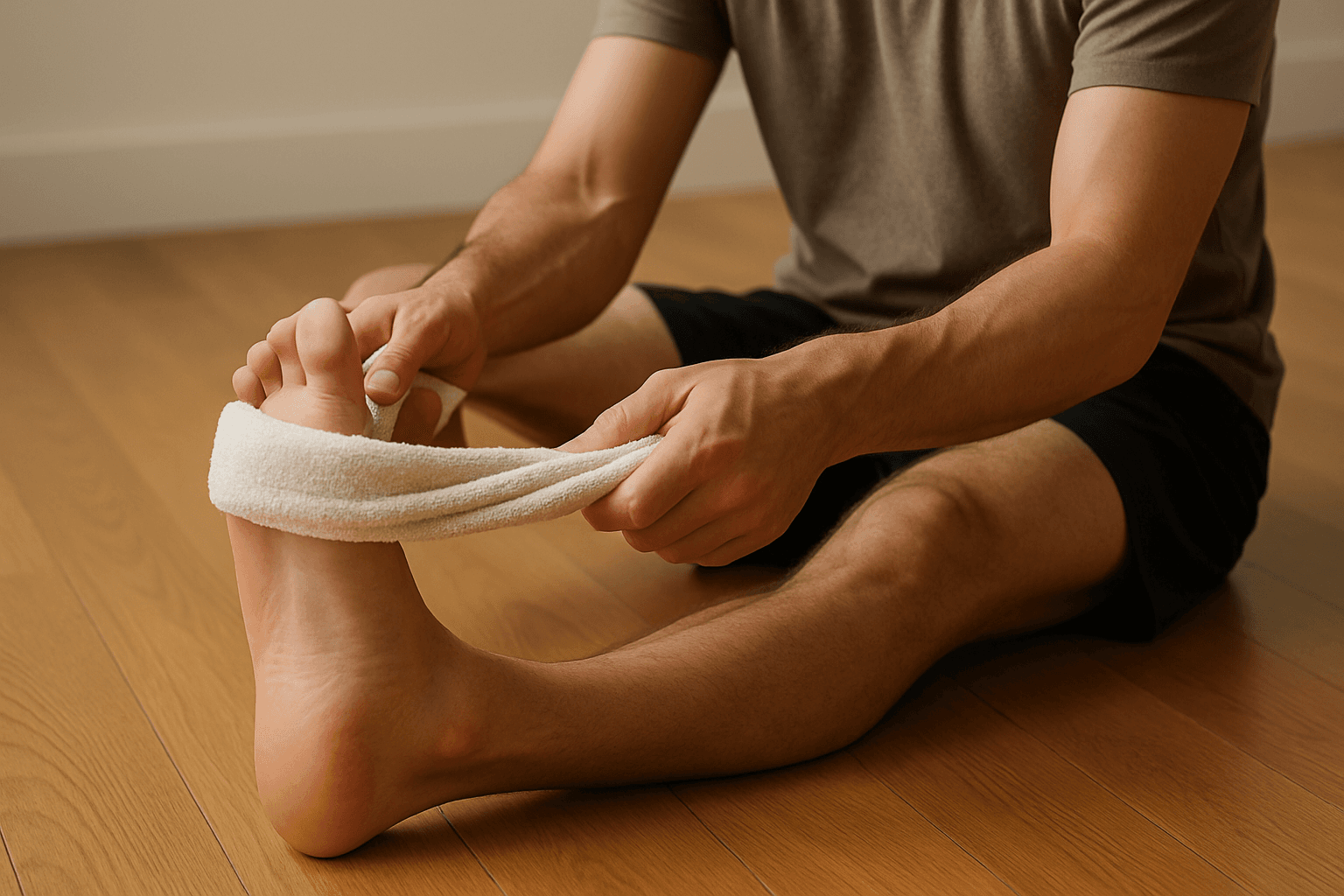
Sit up in bed with your legs straight out in front of you. Loop a bath towel, dog leash or yoga strap around the ball of one foot and gently pull the toes back toward your shin, keeping the knee straight. You are aiming for a firm stretch through the calf and along the sole, not a searing one. Hold for thirty seconds, relax for a beat, and repeat three times per foot.
This stretch lengthens the fascia while it is still short from a night of rest — before your body weight lands on it. Most first-step heel pain traces back to that overnight shortening, and giving the tissue a gentle wake-up call under your own control (rather than under 150-plus pounds of you) is why the morning pain fades within days for a lot of people. It is worth setting the towel on your nightstand so you cannot forget.
Standing calf stretch against a wall
Face a wall with both hands on it, one foot forward and the sore foot straight back with the heel flat on the floor. Keeping the back knee straight and the back heel pressed down, lean your hips toward the wall until you feel a stretch high in the calf. Hold thirty seconds, then bend the back knee slightly and reangle so the stretch moves down toward the Achilles and lower calf. Hold another thirty seconds. Do three rounds on each side.
The gastrocnemius (upper calf) and soleus (lower calf) share the Achilles tendon, and both have to be flexible for the heel to move well. A tight soleus in particular is a common finding in stubborn plantar fasciitis, and the bent-knee version of this stretch is what unlocks it. Do this one after any long walk or run, not just morning and night.
Stair or curb calf drop
Stand on the edge of a stair with the balls of both feet on the step and the heels hanging off. Hold the railing. Slowly lower the heel of the sore side below the level of the step, letting the weight of your body pull the calf into a stretch. Hold for twenty to thirty seconds, then lift back up. Three repetitions.
This is a deeper version of the wall stretch and puts a small eccentric load through the calf and Achilles — the same principle physical therapists use for tendinopathy. If a full heel drop is too much at first, do a half drop and progress over a week. Stop before pain, not through it.
Seated fascia stretch (the big-toe pull)
Sit down and cross the sore foot over the opposite knee so the sole faces up. Grasp the toes with the same-side hand and pull them back toward the shin until you feel a stretch along the arch. Use the other hand to press gently into the middle of the arch; you should be able to feel a firm cord — that is the fascia. Hold thirty seconds. Repeat three times per foot.
Direct fascia stretching, done morning and night, has good evidence behind it — a well-known 2003 trial by DiGiovanni and colleagues found this specific stretch outperformed generic calf stretching for morning pain. It is worth adding to whatever else you do.
Rolling the arch
Sit in a chair and put a frozen water bottle, tennis ball or dedicated massage ball under the sore foot. Roll it slowly from the ball of the foot to just in front of the heel, pressing down as hard as feels good — not more. Two to three minutes per foot, once or twice a day. The cold bottle option adds an ice-massage effect that many people find calms the tissue after a long day.
This is technically self-massage rather than a stretch, but it belongs in the routine because it loosens the fascia along its length between the arch-and-calf stretches. Our full walk-through lives on the plantar fasciitis massage page.
Toe splay and towel scrunches for the small foot muscles
Bare-footed, put a small hand towel on a smooth floor and use your toes to scrunch it toward you, then push it back out. Repeat for one to two minutes. Follow with sets of toe splays — spread the toes as wide as you can, hold five seconds, relax. Ten reps.
Plantar fasciitis is not only a fascia problem. The intrinsic muscles of the foot — the small ones between the arch and the toes — help stabilize the arch and take some of the load off the fascia. When they are weak, the fascia does more work. These are boring, low-load exercises, and that is the point.
How to fit it into a real day
Morning, before standing: towel stretch in bed (2 min). After breakfast: wall calf stretch and seated fascia stretch (4 min). Evening, on the couch: rolling the arch and toe splays (5 min). That is under fifteen minutes total, spread out, and it does more than an hour of stretching once a week.
Give the routine three to four weeks before deciding whether it is working. Pair it with a supportive insole so that the fascia is not being re-stretched all day between sessions — a firm arch and a deep heel cup in the shoes you already wear is what turns the routine from painful maintenance into real progress. For the shoes that will not fit an insole (dress shoes, dance shoes, cleats), a daily low-dye taping job does the same mechanical unloading of the fascia through the day. Our top pick lives in our Akusoli insoles review; the broader picture is on the plantar fasciitis hub.
See our top insole for plantar fasciitis
A firm arch and deep heel cup pair naturally with a daily stretching routine — here's the trim-to-fit pair we recommend first.
See our top insole for plantar fasciitis →Frequently asked questions
How long does it take for stretching to help plantar fasciitis?
Most people notice softer first-step pain within a week or two of doing the towel stretch before bed and before standing. Full symptom relief usually takes six to twelve weeks of a consistent routine paired with supportive shoes. If nothing has budged after a month of honest daily practice, add a supportive insole or see a clinician for a hands-on assessment.
Should I stretch through the pain?
No. A firm pulling sensation in the calf and along the arch is what you want; sharp pain in the heel is a sign to back off. Reduce the range of motion, shorten the hold, or switch to a gentler version — a bent-knee calf stretch instead of a straight-knee one, for example.
Is stretching enough on its own, or do I also need insoles?
For mild, recent cases stretching alone often does the job. For heel pain that has been around for months, or pain in someone who stands all day, stretching plus a supportive insole tends to work far better than either alone. The stretches lengthen the tissue; the insole prevents it from being overloaded between stretches.
How often should I do these stretches?
Twice a day is the sweet spot for most people — before your feet hit the floor in the morning and again in the evening. Add a mid-shift round if you stand all day. Doing them once a day works too; skipping days is when progress stalls.
Are there stretches I should avoid with plantar fasciitis?
Anything that puts you into a deep loaded squat with heels off the ground can aggravate a sore fascia early on. Ballistic bouncing stretches are also worth skipping — hold each position instead. If you have a heel spur diagnosis, aggressive rolling directly on the heel bone can sting; roll the arch just in front of the heel instead.
When should I see a doctor instead of stretching more?
See a clinician if home care has not moved the needle after four to six weeks, if pain is severe enough to change how you walk, if there is swelling, numbness or tingling, or if the pain followed a specific injury. Persistent heel pain in children or teenagers is a different problem and always deserves an in-person exam.
HeelCups is reader-supported. When you buy through links on our site we may earn an affiliate commission, at no extra cost to you. This article is general information about foot comfort and is not medical advice — see our medical disclaimer.