SHOES
Doctor-Recommended Shoes for Plantar Fasciitis: What Actually Earns the Label
"Podiatrist-recommended" is not a brand — it is a short checklist of features any decent walking shoe can hit. Here is the checklist, how to spot each feature on a shelf, and why the shoe alone is only half of the picture.
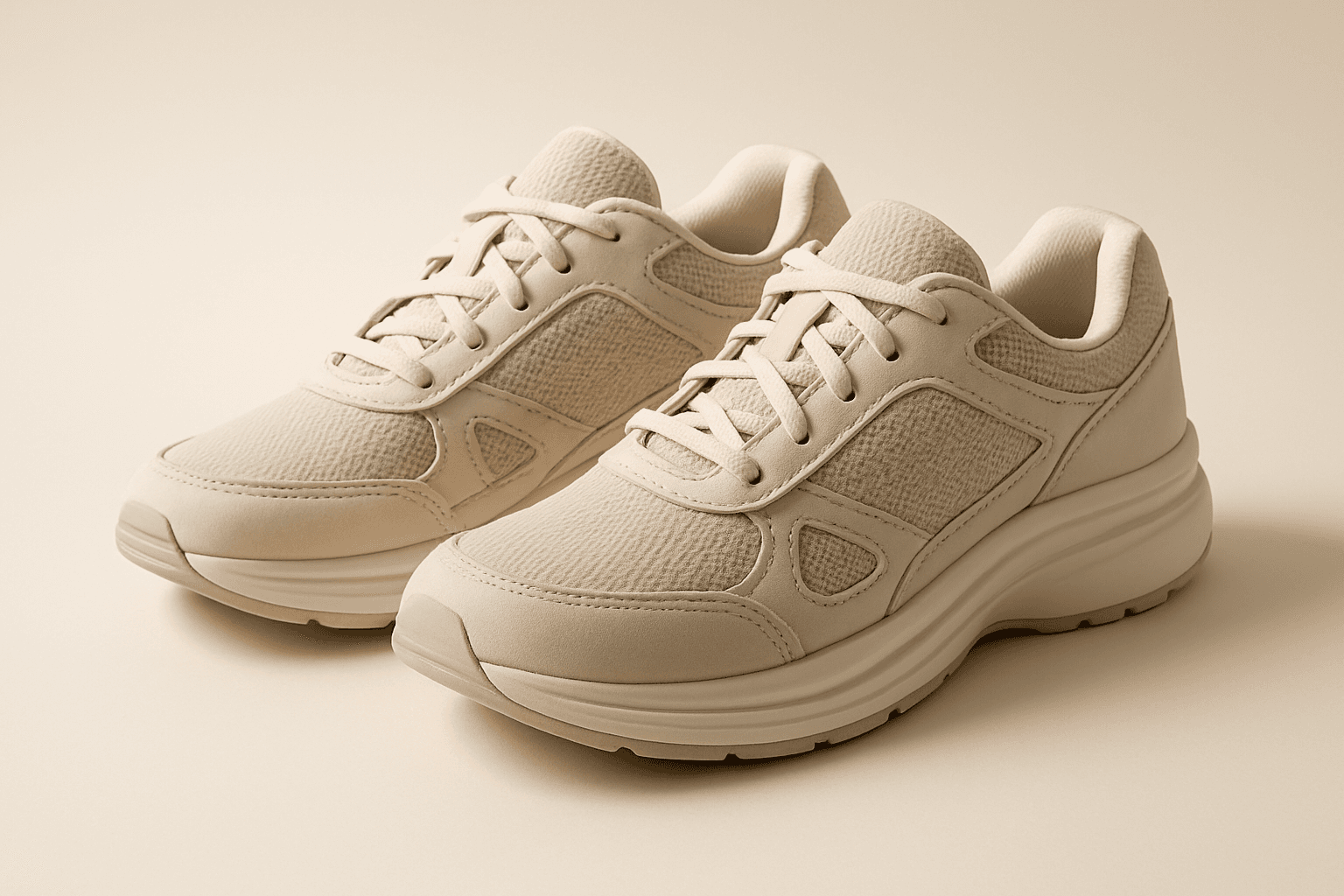
When a podiatrist says a shoe is "good for plantar fasciitis," they are almost never handing you a single model. They are describing a set of features that most brands offer somewhere in their lineup — a firm heel counter that keeps the heel bone from tilting, a supportive arch that resists collapse under body weight, a stiff torsion through the mid-foot, a moderate stack height that puts real material between the foot and the sidewalk, and a flex point that hits under the ball of the foot rather than under the arch. Learn what each feature does, and you can walk into any store and hold up two shoes to tell which one is doing the work.
The shoes that keep landing on podiatrist-recommended lists — New Balance's 990 and 928 walking series, the Brooks Addiction Walker, Hoka's Bondi and Clifton, the ASICS Gel-Kayano, Vionic walking shoes, and orthopedic-focused makers like SAS, Aetrex and Orthofeet — are on those lists because they hit most or all of the checklist below. They are not magical, and no lab has proven any one of them best for plantar fasciitis. A generic walking shoe with the same features can do the same job, and a marquee running shoe without them will not, however well it reviews on running blogs.
This page walks the checklist and shows how to test each feature with the shoe in your hands. Nothing here is medical advice — a podiatrist's in-person read of your foot, your gait and your day-to-day life is always more specific than a website's list. Persistent heel pain that has not eased after four to six weeks of honest home care deserves an in-person exam by a doctor or podiatrist. Every recommendation on this hub is written for comfort, support and relief. Planning to take them off-road? See hiking with plantar fasciitis.
A firm heel counter that keeps the heel bone in place
The heel counter is the stiff cup at the back of the shoe that wraps around the heel bone. In a plantar-fasciitis-friendly shoe, that cup is genuinely rigid — squeeze the back of the shoe between your thumb and finger and it should refuse to fold. The job is to keep the heel bone from tilting side to side with each step. When the heel wobbles, the plantar fascia is torqued at its attachment on the underside of the heel, which is the exact tissue you are trying to give a rest.
Most performance running shoes have firmer heel counters than most fashion sneakers. Motion-control and stability lines (the Brooks Beast, the ASICS Kayano, the Saucony Guide) are firmer still. Slip-on lifestyle sneakers with an unstructured back are the opposite end of the range and are the wrong shoe for an active plantar fasciitis flare, however comfortable they feel in the store.
Real arch support built into the shoe, not just marketing
"Arch support" prints on almost every shoe box. What matters is whether the shoe's midsole has a shaped, firm region under the medial arch that resists collapse under body weight. Pull the shoe's factory insole out and press on the exposed footbed with your thumb — if you can push it flat easily, the shoe is providing very little arch support, and any real support will need to come from an aftermarket insole. If the footbed shape holds, the shoe is doing at least some of the work on its own.
For most readers with plantar fasciitis, a shoe with modest built-in arch support paired with a real supportive insole outperforms a "maximum support" shoe with a soft factory insole. Our Akusoli insoles review covers the pair we would drop into most walking shoes; the buyer's-guide walk-through lives on our insoles for plantar fasciitis sub-page. Both the shoe and the insole need to earn their place.
Torsional rigidity through the mid-foot
Hold the shoe by the toe and heel and try to twist it like a wet towel. A shoe with good torsional rigidity refuses; a bendy shoe folds easily. The mid-foot region — the shank, under the arch — needs to hold its shape while the toes and heel do their own bending. Shoes with a rigid plate or dense EVA through the shank are what you are looking for. Ballet-flat-style shoes and thin canvas sneakers fail this test badly, which is why they can be rough on a plantar-fasciitis foot after even a short walk.
You can feel the difference in the first block. A twist-resistant shoe holds the arch steady as your weight rolls across the foot; a limp shoe lets the whole midfoot flatten with each step and asks the fascia to catch what the shoe should have caught. That is the mechanical reason a supportive shoe pairs well with the plantar fasciitis stretches routine — the shoe stops the tissue being re-loaded between sessions.
A stack height that puts real material under the heel
Stack height is the thickness of the midsole between your foot and the ground. A stack of roughly 25 to 35 mm under the heel is the range most walking-shoe specialists point at for people with foot pain — enough cushioning to blunt the impact of concrete, not so much that the foot loses stability. Racing flats and minimalist "barefoot" shoes have almost no stack height and put every ground impact straight into the fat pad and the fascia; that is the wrong direction while the tissue is flaring.
Hoka's maximum-cushion approach (Bondi, Clifton) and orthopedic brands like SAS run at the higher end of that range. Traditional running and walking shoes sit in the middle. Fashion sneakers vary wildly — the same brand may make a shoe with 30 mm of stack and one with 10 mm, and they will feel entirely different under a sore heel.
A flex point under the ball of the foot, not under the arch
Hold the shoe on a flat surface and press down on the heel and toe until the shoe bends. It should bend upward at the ball of the foot — under the joint of the big toe — not at the arch. A shoe that folds in the middle is telling you the shank is not stiff enough for what you are asking of it. That is a shoe for a healthy foot. For plantar fasciitis, the arch needs to stay supported through the step, and only the forefoot needs to flex to push off.
This is the single easiest feature to check in a store, and it filters out a surprising number of shoes marketed for foot pain. Try it before you try anything on.
A slight heel-to-toe drop for the acute phase
Heel-to-toe drop is the difference in stack height between the heel and the forefoot. A drop of 8 to 12 mm — traditional running-shoe territory — is easier on a sore fascia than a zero-drop or four-drop shoe, because it takes tension off the Achilles and, downstream, off the plantar fascia. Zero-drop shoes and minimalist trail runners are a return-to-normal choice, not an acute-flare choice. Give the tissue the higher heel while it calms down; drop back to a lower differential once the pain has been quiet for a while.
Runners often ask whether the drop of their beloved training shoe is the problem. In our experience it usually is not the drop by itself — it is the drop plus a low-stack, low-support ride, all of which combine to hand the fascia more work than it has right now. A stability trainer with a modest drop and a firm midfoot usually keeps runners moving through a flare far better than a switch to a completely different shoe category.
Fit, width and volume — the details that break the checklist
The best-featured shoe in the world does not help in the wrong size. Feet swell across the day, so shop shoes in the afternoon or evening rather than the morning. Aim for a thumbnail of space between your longest toe and the front of the shoe with your usual sock on. If your foot is wider than a D (men) or B (women), buy the wide version — squeezed toes and a compressed forefoot make everything worse, including how the fascia loads. High-volume feet often do better sizing up a half and lacing snug through the mid-foot than trying to force a smaller shoe on. Slip your supportive insole into the shoe before deciding on size; an aftermarket insole eats a small amount of internal volume.
Try both shoes on together, walk twenty steps on a hard surface (not the store's soft carpet), and do the twist and press test one more time with the shoe on your foot. Buy the pair that ticks the checklist, fits your specific foot and feels quietly supportive in the first block — not the pair that feels the softest.
Where to try the checklist and what to skip
Any decent walking or stability running shoe from a brand that has been making them for twenty years — New Balance, Brooks, ASICS, Saucony, Hoka — and the orthopedic-first makers SAS, Vionic, Aetrex and Orthofeet all have models that hit the checklist somewhere in their lineup. Do not lean on brand loyalty; check the specific shoe against the six features above. Pair whatever you pick with the plantar fasciitis stretches routine morning and night, and with a supportive aftermarket insole in the shoes you wear the most hours in.
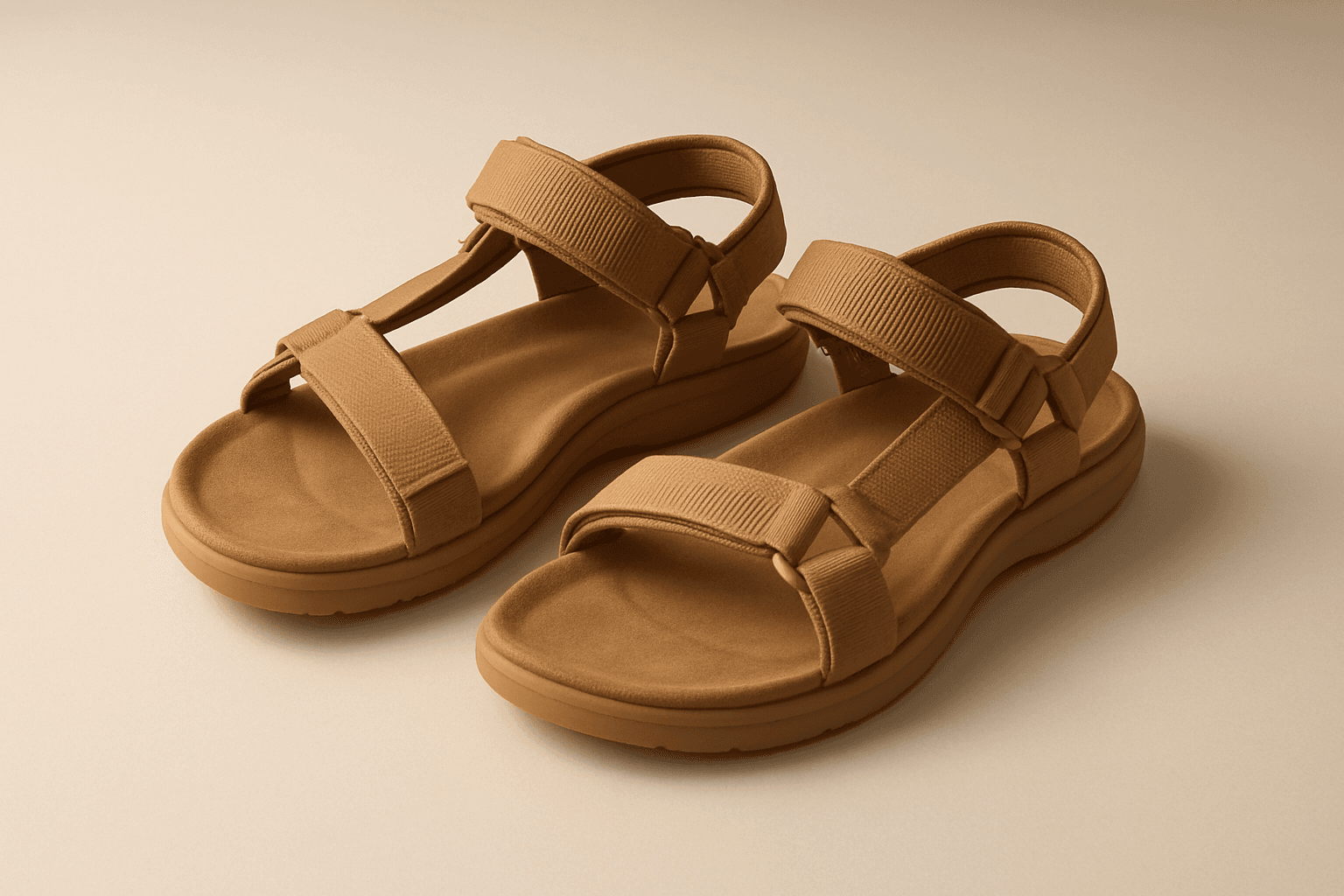
What to skip while the fascia is flaring: flat canvas sneakers, thin ballet flats, unstructured slip-ons, worn-out running shoes past their mileage, and any dress shoe or sandal with no arch structure and no heel counter. A short summer of flat sandals on hard floors is a classic lead-in to a fresh plantar fasciitis episode. Keep the ones you love; save them for shorter days once the pain has been quiet for a month.
The supportive insole that pairs with any of these shoes
A firm medial arch and a deep heel cup — the aftermarket insert we would drop into a mainstream walking shoe first.
The supportive insole that pairs with any of these shoes →Frequently asked questions
Do I need a special "plantar fasciitis shoe" or is any supportive shoe fine?
Any shoe that meets the checklist — firm heel counter, real arch support, torsional rigidity, moderate stack height, forefoot flex, 8 to 12 mm drop — behaves like a "plantar fasciitis shoe." "Podiatrist-recommended" describes features, not a brand. A well-featured walking shoe from a mainstream maker often outperforms a niche "PF shoe" that skips one of them.
Are barefoot or minimalist shoes ever okay for plantar fasciitis?
Not while the fascia is actively inflamed. Zero-drop, thin-soled shoes put every ground impact through the fat pad and the fascia and load the calf harder, which pulls the heel bone up and puts more tension on the fascia. Once symptoms have been fully quiet for a few months, a gradual return to lower-drop shoes on soft surfaces suits many people; an acute flare is not the moment.
Should an aftermarket insole go in on top of the factory one or replace it?
Replace it. Most factory insoles are thin foam with no real arch shape. Pull it out and slide the supportive insole in on top of the exposed footbed. If the fit is tight, trim the new insole a shade smaller using the factory one as a template.
How much should a doctor-recommended plantar fasciitis shoe cost?
A well-featured walking or stability running shoe from a mainstream brand runs roughly $110 to $180 at retail, with last-season models regularly on sale in the $80 to $120 range. Orthopedic-focused brands like SAS and Orthofeet often sit $150 to $220. Custom-orthotic-friendly shoes at podiatry-clinic stores anchor the top of that range.
Are there dress shoes or sandals that work for plantar fasciitis?
Yes — Vionic, Orthofeet, Aetrex and a few dress-focused orthopedic brands make dress shoes and sandals with real arch structure and a firm heel that meet most of the checklist. Flip-flops with no arch and pointy-toed fashion shoes do not. If you have to wear dress shoes for work, look for a pair that accepts an aftermarket insole and pair them with the insoles for plantar fasciitis you already trust.
When is it time to see a podiatrist instead of another shoe?
If honest home care with a well-featured shoe and a supportive insole has not moved the pain after four to six weeks, if you have a rigid high arch, a severe flatfoot or a diagnosis like a heel spur with complicating factors, a podiatrist can fit a custom orthotic and pair it with a specific shoe. That combination outperforms off-the-shelf in the stubborn cases and is where the money is best spent once the basics have been tried honestly.
HeelCups is reader-supported. When you buy through links on our site we may earn an affiliate commission, at no extra cost to you. This article is general information about foot comfort and is not medical advice — see our medical disclaimer.