SHOCKWAVE THERAPY
Shockwave Therapy for Plantar Fasciitis: What It Is, Who It Helps, and Where It Sits on the Ladder
Extracorporeal shockwave therapy is the most-studied second-line option for stubborn plantar fasciitis — non-invasive, non-pharmacologic, and quietly useful in a narrow slice of chronic cases. Here is what the sessions feel like, which cases it tends to help, and the honest read on cost and evidence.
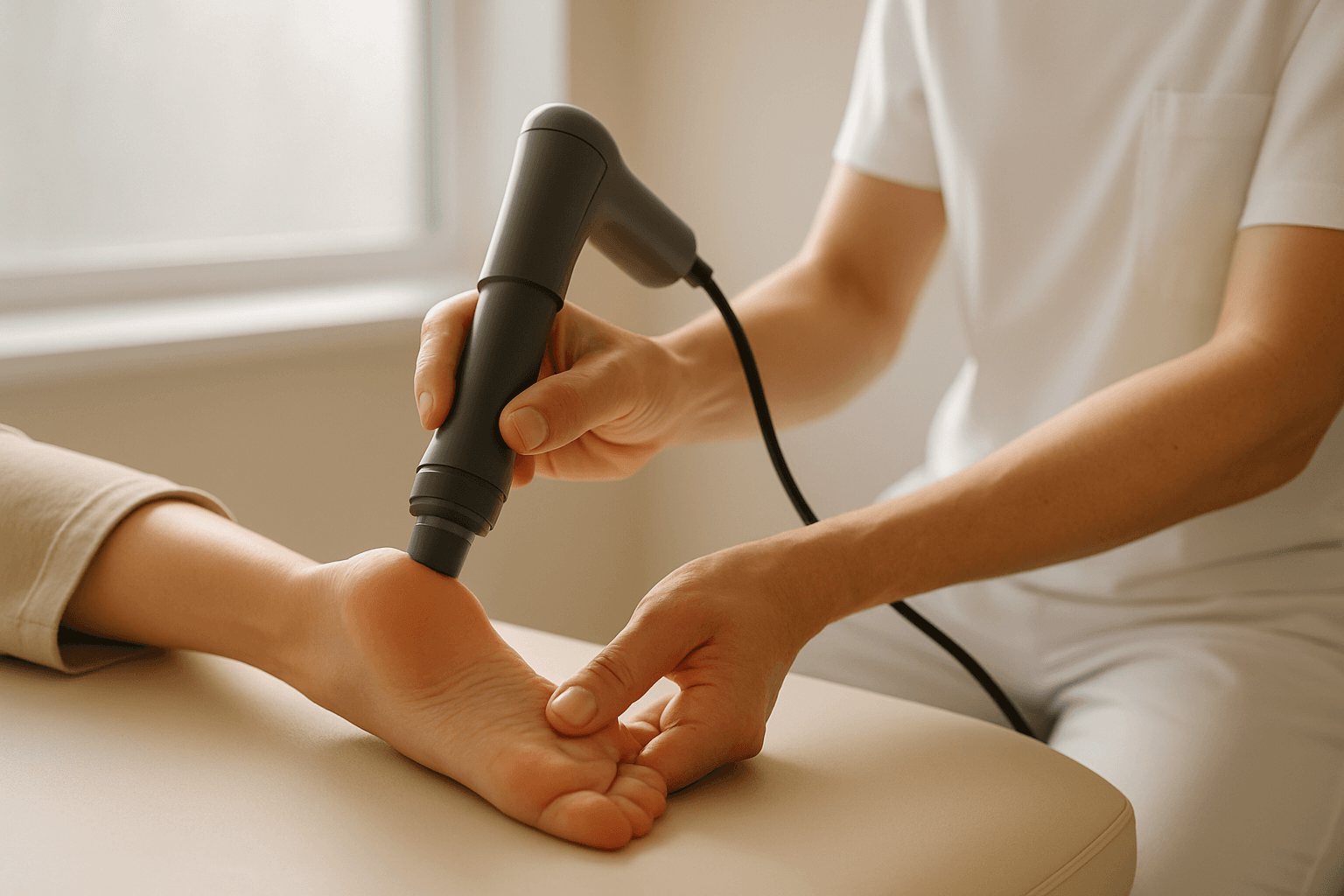
Shockwave therapy — formally extracorporeal shockwave therapy, usually written ESWT in a clinic note — is an in-office sound-wave treatment delivered through a hand-held wand pressed against the sore spot on the heel. In the United States it is cleared by the FDA for chronic plantar fasciitis that has not responded to at least six months of conservative care, and in the right case it is the most evidence-based next step before an injection or any surgical conversation. For the right reader it also sits in a strange middle ground: non-invasive, non-pharmacologic, moderately expensive, and quietly useful in a specific population that is not every reader with heel pain.
If your first steps of the morning still stab and you are reading this at week four of calf stretches and a supportive insole, you are not the audience for this page. Our plantar fasciitis treatment walk-through is where to start — the daily plan handles the overwhelming majority of cases before any clinic becomes necessary, and shortcutting to a shockwave course without the groundwork is a common way to spend eight hundred dollars for a disappointing result. If you are at month six or month twelve, you have been honest about the daily routine and the shoe changes, and the fascia has still not quieted, shockwave therapy is one of the three options a podiatrist or an orthopedist will usually float next (the other two being a corticosteroid injection and, in a smaller number of stubborn cases, a surgical conversation covered in our plantar fasciitis surgery walk-through).
Nothing on this page is medical advice, and shockwave therapy is a clinic procedure that belongs with a trained foot-and-ankle clinician. The right person to tell you whether you are a candidate is a podiatrist or an orthopedist with foot-and-ankle experience; this page is to help you walk into that visit with the right questions. Every recommendation on this hub is written for comfort, support and relief — nothing on this site is a treatment or a cure for plantar fasciitis.
What shockwave therapy actually is
Extracorporeal shockwave therapy delivers short pulses of acoustic energy through the skin and into the sore tissue underneath. The energy is generated outside the body (the extracorporeal in the name) by one of two mechanisms. A focused shockwave device uses an electromagnetic or piezoelectric generator to concentrate a sharp wave at a specific depth, usually three to four centimeters into the tissue; a radial shockwave device uses a pneumatic hammer to spread a softer wave across a wider surface area at a shallower depth. Both are called shockwave in common usage, but a clinician usually means focused when they say 'ESWT' and radial when they say 'radial pressure wave therapy' or 'RSWT.' For plantar fasciitis the research base is larger for focused shockwave at the fascia's heel attachment, though many clinics use radial devices on heel pain with reasonable results.
The therapeutic idea is that the acoustic energy causes microscopic mechanical disruption at the sore site, which triggers a controlled inflammatory healing response, improves local blood flow, and nudges a stalled chronic injury back into a repair phase. It is not an injection, not a drug, and not a direct physical breaking-down of a heel spur in the way the name sometimes suggests to patients. The spur itself is almost never the pain generator in plantar fasciitis — the inflamed fascia is — and whatever benefit a session produces comes from its effect on the soft tissue at the heel attachment, not on the bone.
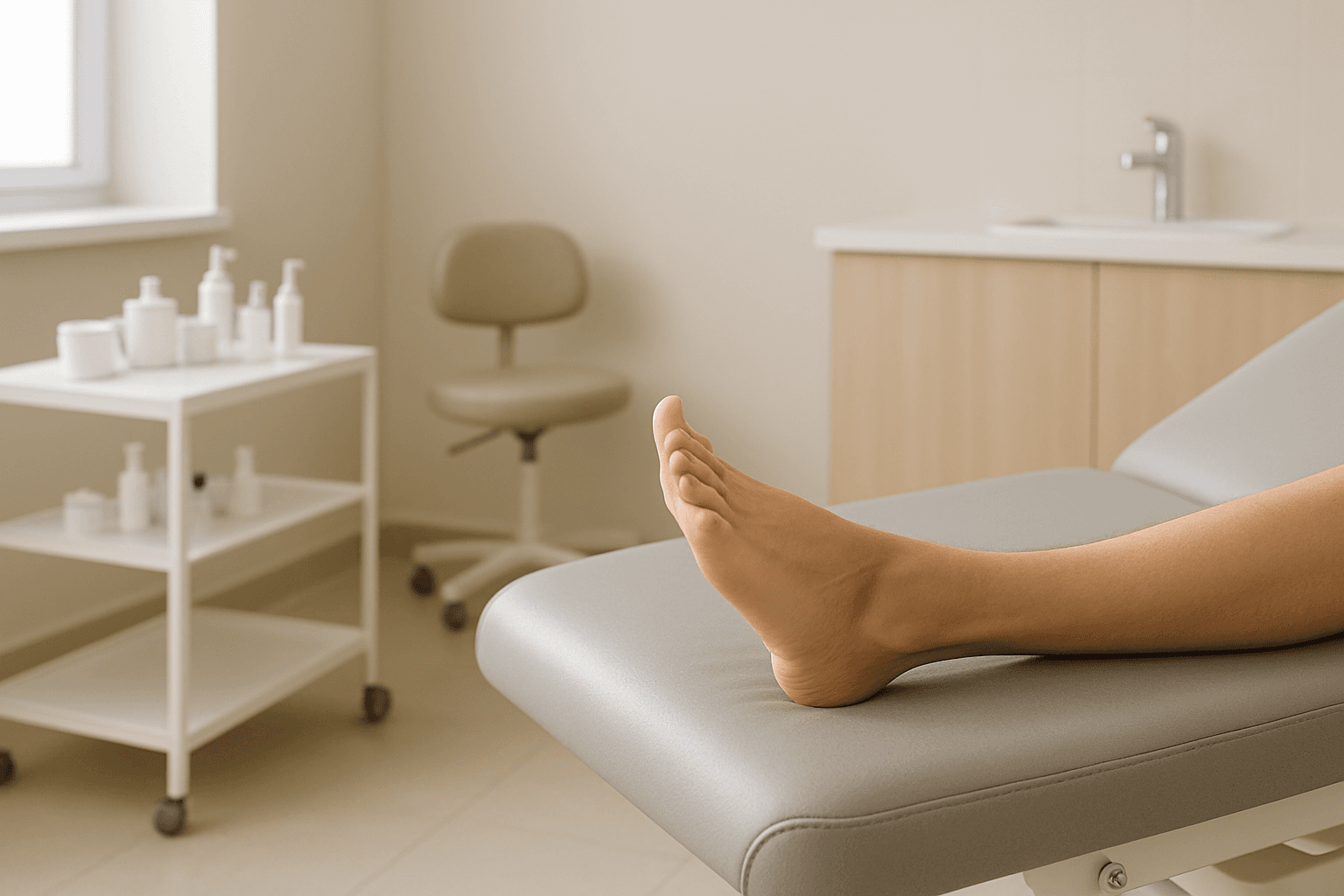
The practical experience is unglamorous. You lie on an exam table, the clinician applies ultrasound gel to the sore spot and places the wand against it, and the device delivers somewhere between fifteen hundred and three thousand pulses over five to ten minutes while the energy is dialed up to the level you can tolerate. Focused shockwave is often described as a sharp tap or a strong pulse at each strike; radial feels more like a jackhammer thud. Most readers rate the sensation a four or five on a ten-point scale at full therapeutic energy; it is uncomfortable rather than unbearable, and some clinics will offer a local anesthetic or a nerve block for patients who need one.
The honest read on the evidence
Shockwave therapy for chronic plantar fasciitis has the largest clinical trial base of any second-line foot pain treatment and has consistently landed in the useful-but-not-miraculous bucket. A 2020 systematic review in the British Journal of Sports Medicine of randomized trials of ESWT versus placebo and versus other conservative care found moderate-quality evidence of a meaningful reduction in pain and improvement in function at three to six months after a course of treatment, with effect sizes similar to or slightly better than a cortisone injection and a longer-lasting benefit. A 2022 Cochrane-style meta-analysis of focused ESWT reached similar conclusions, with the caveat that trial quality varies and some older studies used energy settings now considered subtherapeutic. The FDA cleared the Dornier Epos Ultra focused shockwave device for chronic plantar fasciitis in 2000 and multiple other devices since, under the broad umbrella of chronic recalcitrant plantar fasciitis that has failed six months of conservative care.
The useful translation of 'moderate effect size' is that in the trial populations — which are themselves selected for stubborn, six-plus-month plantar fasciitis — somewhere between sixty and seventy-five percent of patients report meaningful improvement in heel pain at three months after a three-session course, and roughly half still report meaningful benefit at twelve months. That is not every patient, and it is not a cure. It is, on the other hand, better than the natural history of chronic plantar fasciitis at the same time point, better than most of the gadgets sold online for the same price, and in the ballpark of what a corticosteroid injection offers at three months with less of the risk profile.
What shockwave does not do is reliably solve the problem for the acute flare that is three weeks old. Trials of shockwave in that early population have been uneven, and most clinicians save the treatment for cases that have earned their chronic label with at least six months of honest conservative care first. It also does not substitute for the daily routine. Patients who return to the shoe, stretch, and load habits that produced the flare in the first place are the group that reports the pain creeping back by month six.
Who the treatment is designed for
The textbook candidate is an adult with heel pain under the medial heel attachment of the fascia that has lasted more than six months, has been documented with examination (and often with ultrasound showing a thickened plantar fascia at the heel attachment), and has not responded to a legitimate stretch of conservative care: a supportive shoe, a firm-arched insole, daily calf and fascia stretching, a short course of NSAIDs or physical therapy, and ideally a trial of a night splint. Our plantar fasciitis stretches and plantar fasciitis night splint walk-throughs cover the groundwork that comes first.
Shockwave therapy is contraindicated in a short list of situations that your clinician will ask about: pregnancy (the device is not applied over a pregnant abdomen, and there is theoretical caution about distal application too), bleeding disorders or anticoagulant medication at full therapeutic dose, local infection or an open wound over the treatment site, a pacemaker if the device is to be used near the chest (not relevant for heel treatment, but a routine question), and an active malignancy at the treatment site. It is also usually not offered to adolescents with open growth plates, because the long-term effect on growing bone is not well characterized; a child or teenager with heel pain is far more likely to have Sever's disease than adult-style plantar fasciitis anyway.
The population that responds least well is the one with a very long history (two or three years), significant comorbid obesity that has not been addressed, and a daily life that has not changed between the first visit and the shockwave visit. The soft-tissue repair response that shockwave triggers happens inside a biomechanical environment, and nothing about the acoustic pulse makes a twelve-hour shift in flat canvas shoes less of a daily load. Patients who use the course of shockwave as a reset button to lock in supportive shoes, a serious insole and a stretch routine do markedly better than patients who go back to the pre-flare life as soon as the sessions are over.
What a course of treatment looks like
The standard protocol for chronic plantar fasciitis is three focused shockwave sessions spaced one to two weeks apart, each session delivering somewhere between fifteen hundred and three thousand pulses at an energy level tailored to the patient's tolerance (typically 0.20 to 0.40 millijoules per square millimeter for focused devices). Radial protocols sometimes stretch to five sessions. Each session is twenty to thirty minutes of chair time, five to ten minutes of which is the actual treatment. Between sessions the patient keeps up normal activity, with permission to continue running or working as tolerated — shockwave does not require immobilization or a boot.
A short-term soreness around the heel for one to three days after each session is the most common side effect, and it responds to ice, acetaminophen and reduced activity. A small bruise over the treatment site is common. More serious adverse events are rare in the published series: occasional reports of transient numbness, superficial skin reactions, and (very rarely) a plantar fascia tear in a patient who may have been predisposed to one. Patients are usually advised not to take NSAIDs in the forty-eight hours before and after each session, because the inflammatory response triggered by the device is part of the therapeutic mechanism.
Response timing is slower than a cortisone injection and faster than natural history. Most patients notice early change at four to six weeks after the final session; the full response is usually visible by twelve weeks. If there is no change by twelve weeks a second course is sometimes offered, though evidence for a second course is thinner than for the first. Patients are told to keep the stretch routine, the shoe choices and the insole running through and after the course — our Akusoli insoles review is the pair we would install in the shoe you wear most during a shockwave trial.
Where shockwave sits on the ladder
The treatment ladder for chronic plantar fasciitis in a mainstream podiatry or sports-medicine practice runs roughly: an eight-to-twelve-week stretch of basic conservative care, a formal physical therapy course if available, a trial of a night splint, a short course of oral NSAIDs or a corticosteroid injection, extracorporeal shockwave therapy, and — rarely — a surgical conversation. Shockwave sits above the injection in several practices because the benefit is longer-lasting and the risk profile is friendlier: no plantar fascia rupture risk the way a cortisone injection can carry, no fat pad atrophy from repeated injections, no systemic steroid exposure. Where a cortisone injection remains attractive is when a patient needs a short, sharp reduction in pain to get back to normal function for a specific event — a wedding, a work travel period, a return-to-run deadline — and does not have the four-week horizon that shockwave requires to show results.
Platelet-rich plasma (PRP) injection sits adjacent to shockwave on the ladder and has a growing but less consistent evidence base for plantar fasciitis. Several head-to-head trials have found PRP and shockwave roughly equivalent at three and six months, with PRP costing more per treatment in most markets and less covered by insurance. For a patient weighing both, availability and cost are usually the deciding factors — the clinical signal does not strongly prefer one over the other for most cases.
Surgical options for plantar fasciitis — partial plantar fasciotomy most commonly — are reserved for the small minority of patients who have failed six to twelve months of honest conservative care including shockwave or injection. Our plantar fasciitis surgery walk-through covers what the operation involves, what recovery actually looks like, and the honest read on long-term outcomes. For readers with chronic heel pain that also sits at the back of the heel, heel spur treatment is a cousin conversation — shockwave has evidence there too, with slightly different protocols.
Cost, access and what to ask before you book
A three-session course of focused shockwave therapy in a United States podiatry or orthopedic clinic typically runs five hundred to twelve hundred dollars out of pocket, with meaningful regional variation. Insurance coverage is inconsistent. Medicare has historically not covered ESWT for plantar fasciitis despite the FDA clearance, treating it as 'investigational' at the national coverage policy level. Private insurance varies plan by plan, and the pre-visit call to your insurer to check coverage is worth ten minutes of hold time. Radial shockwave is often cheaper per session than focused shockwave and more widely available in physical therapy clinics; the trade-off is a somewhat thinner evidence base specifically for the heel.
Access has improved in the last five years. A decade ago shockwave was concentrated in specialty foot-and-ankle practices and a handful of academic sports-medicine centers; today many podiatry practices and a growing share of physical therapy clinics offer either focused or radial devices as part of their lineup. The useful questions to ask before you book are: (1) is this focused or radial shockwave, (2) how many pulses per session and at what energy level, (3) how many sessions is the protocol, (4) what is the all-in cost of the full course, and (5) what is the clinic's informal response rate for chronic plantar fasciitis. A clinic that cannot answer the first three questions is probably not the right place to start.
The last thing worth saying is a plain one: shockwave therapy is a comfort-and-relief tool for a stubborn case, not a magic bullet. It raises the odds of a quieter heel at three to six months in a specific population, but it works best when the daily plan has been honest first and continues after. Pain that has not eased after six to twelve months of honest home care, including a legitimate conservative trial, deserves an in-person exam by a podiatrist or an orthopedist to discuss shockwave therapy and the other options at the same point on the ladder.
The daily plan that comes first
Shockwave therapy is a reset for a chronic case — the groundwork of stretches, shoes and insoles is what the course is designed to work with.
The daily plan that comes first →Frequently asked questions
Does shockwave therapy hurt?
At full therapeutic energy most readers rate the sensation a four or five on a ten-point scale — uncomfortable rather than unbearable. Focused shockwave feels like a sharp tap or pulse at each strike; radial shockwave feels more like a jackhammer thud. The energy is dialed up from zero through the first minute or two of each session so your tolerance sets the ceiling, and clinics that specialize in the treatment will offer a local anesthetic or a nerve block for patients who need one. The soreness in the twenty-four to seventy-two hours after a session is usually mild and responds to ice and acetaminophen; NSAIDs are generally not recommended in that window because the therapeutic mechanism is partly inflammatory.
How many shockwave sessions do I need?
The standard protocol for chronic plantar fasciitis with focused shockwave is three sessions spaced one to two weeks apart, each delivering fifteen hundred to three thousand pulses. Radial shockwave protocols sometimes run to five sessions. If there is no meaningful change by twelve weeks after the final session, a second course is occasionally offered, though the evidence for a second course is thinner than for the first. The treatment is not a weekly standing appointment — it is a defined course with a response window of six to twelve weeks after completion.
Is shockwave covered by insurance?
Coverage is inconsistent. Medicare has historically not covered extracorporeal shockwave therapy for plantar fasciitis despite the FDA clearance. Private insurance varies plan by plan — some plans cover it with prior authorization and a specific diagnostic code (ICD-10 M72.2 for plantar fasciitis), many consider it investigational and exclude it. The pre-visit call to your insurer to check coverage is worth ten minutes of hold time. Out-of-pocket cost for a three-session course in the United States typically runs five hundred to twelve hundred dollars.
How is shockwave different from a cortisone injection?
A corticosteroid injection delivers an anti-inflammatory medication directly to the sore tissue; shockwave delivers mechanical acoustic energy that triggers a controlled healing response. The injection usually produces faster pain relief (within one to two weeks), but the benefit is often shorter-lasting (several weeks to a few months) and repeated injections carry small risks of plantar fascia rupture and fat pad atrophy. Shockwave is slower to work (six to twelve weeks to full response) but the benefit lasts longer in trial populations, and the risk profile is friendlier. Many clinicians use the two sequentially — an injection to settle an acute flare, then shockwave if the pain has not resolved in a few months — rather than treating them as competing options.
Is focused or radial shockwave better for plantar fasciitis?
The research base is larger for focused shockwave at the plantar fascia's heel attachment, and most of the FDA-cleared protocols for chronic plantar fasciitis use focused devices. Radial shockwave is more widely available (many physical therapy clinics have radial devices), typically cheaper per session, and has reasonable but less specific evidence for heel pain. For a patient with a stubborn chronic case who has access to both, focused shockwave is the more evidence-based choice; for a patient whose nearest option is radial, the practical answer is that radial is still a legitimate second-line treatment and worth trying before escalating further.
When should I consider shockwave therapy versus more conservative care?
The textbook answer is after at least six months of honest conservative care — a supportive shoe, a firm-arched insole, daily calf and fascia stretching, a short course of NSAIDs or physical therapy, and ideally a trial of a night splint — that has not produced meaningful change. Patients who shortcut to shockwave at week four or week eight often report disappointing results, partly because the natural history of most plantar fasciitis cases is slow resolution over three to twelve months and partly because the daily load pattern that caused the flare has not been addressed. Shockwave works best as a second-line reset for a case that has earned its chronic label.
HeelCups is reader-supported. When you buy through links on our site we may earn an affiliate commission, at no extra cost to you. This article is general information about foot comfort and is not medical advice — see our medical disclaimer.