TREATMENT
Heel Spur Treatment: What Actually Helps a Painful Heel With a Spur on X-Ray
The spur itself is a downstream response to years of tissue tension — the useful treatment is aimed at the soft tissue around it, not the bony bump. Here is the honest ladder of what helps, from daily habits to injections and surgery.
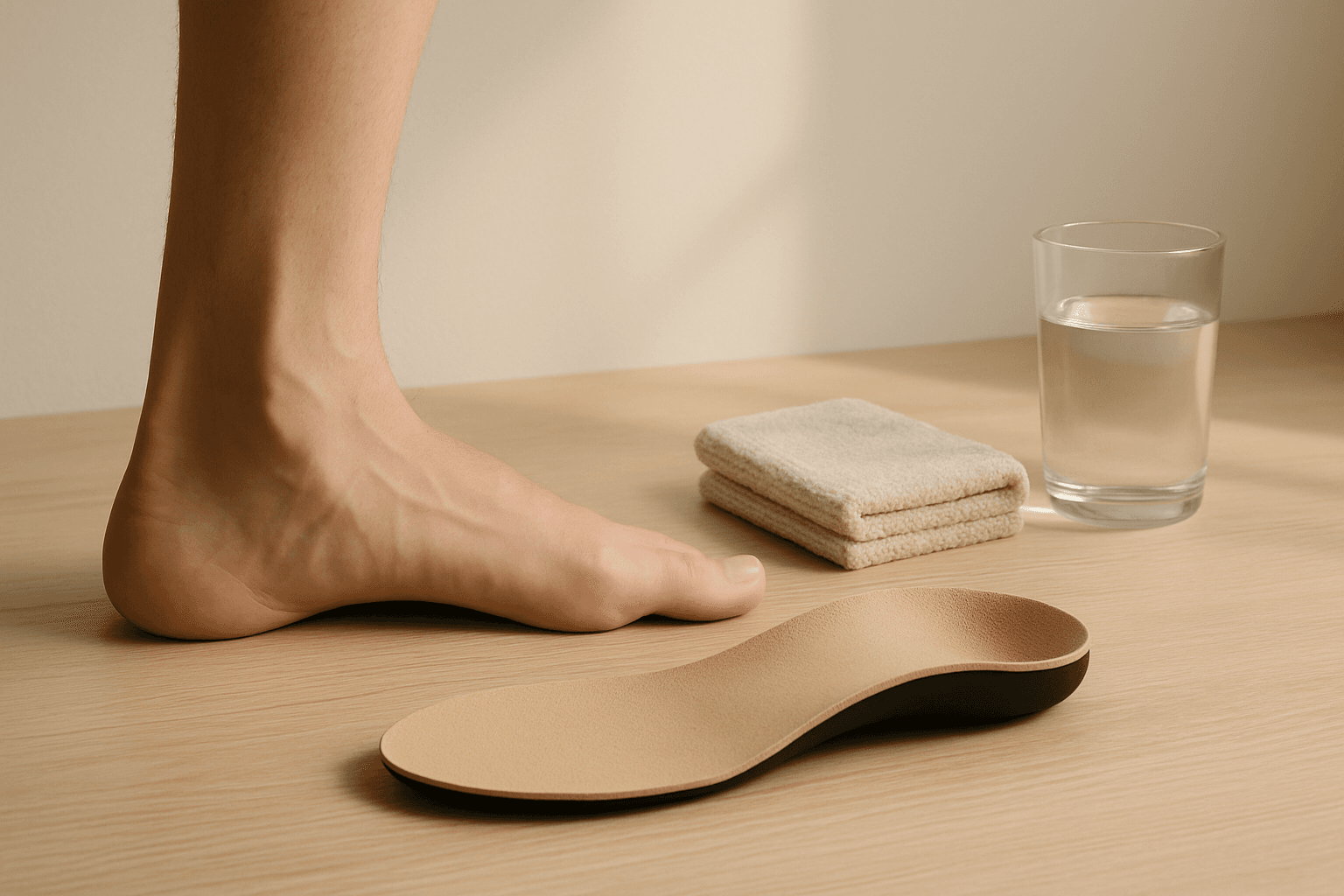
The most important fact about heel spur treatment is that you are not really treating the spur. A calcaneal heel spur is a small bony outgrowth that forms slowly at the front or the back of the heel bone in response to years of tension on the tissue that anchors there — usually the plantar fascia at the underside, sometimes the Achilles at the back. The spur itself is downstream. The tissue tension is upstream. Treatment aimed at the tissue is what quiets a painful heel; treatment aimed at the bone almost never is.
That is why the useful daily plan for a painful heel with a spur looks almost identical to the plan for plantar fasciitis (when the spur sits at the underside of the heel bone) or insertional Achilles tendinopathy (when the spur sits at the back). Stretching, a supportive insole with a firm medial arch and a deep heel cup, a temporary cut in the specific activity that tipped the tissue over, and time. The good news is that most heel spur cases settle with the same conservative care that the underlying condition wants; the honest read is that the ladder takes weeks to months rather than days.
This page walks the treatment ladder from home care through specialist options, when a clinician needs to step in, and the useful truth about which interventions actually target the spur versus the tissue around it. Nothing here is medical advice. Persistent heel pain that has not eased after four to six weeks of honest home care deserves an in-person exam by a doctor or podiatrist. Every recommendation on this hub is written for comfort, support and relief.
First things first: is the spur what actually hurts?
Population imaging studies find heel spurs in something like one in five to one in ten adults, and the large majority of those adults have no heel pain at all. On the other side of that coin, most readers diagnosed with plantar fasciitis do not have a spur on X-ray, and their pain resolves without one ever forming. What that means practically: if you have a spur on X-ray and a painful heel, the picture is almost always inflamed soft tissue around the spur, not the spur itself. A useful treatment plan targets the soft tissue.
There are two rare exceptions. A very large spur at the back of the heel that mechanically rubs against the back of the shoe — sometimes called a pump bump when it sits with a Haglund's deformity — is a shoe-fit problem where the spur itself is the aggressor. And a fresh, sharp spur that has fractured a small piece off the heel bone (usually after a fall or a heavy landing) is a bone-injury picture rather than a soft-tissue one. Both of these need imaging and a clinician's read; they are not the self-care lane.
For every other painful heel with a spur — the vast majority — the treatment ladder starts with the same rungs we use for plantar fasciitis or Achilles tendinopathy, depending on where the spur sits. Our heel spur vs plantar fasciitis walk-through covers the overlap in detail, and our pain in the back of the heel page covers the Achilles-side patterns.
Rung one: the stretching routine and self-massage
For a plantar spur at the underside of the heel bone, the highest-yield daily habit is a short stretching routine morning and evening — a towel or belt stretch of the calf and fascia in bed before your feet touch the floor (thirty seconds, three rounds each side), a step stretch of the calf on a curb (thirty seconds each side), a fascia-specific stretch pulling each big toe upward, and a couple of minutes rolling the arch across a frozen water bottle. Ten minutes total, done consistently for weeks. Our plantar fasciitis stretches walk-through covers the sequence and the form.
For an Achilles-side spur at the back of the heel, the routine is different. Aggressive stretching in the acute phase can make an inflamed Achilles insertion worse; the useful move is a small three-to-six-millimeter heel lift in every shoe to shorten the resting tension on the tendon, and, once the acute pain has settled, a slow eccentric calf loading program. That is a physical-therapist-led program in most cases; the details live on our pain in the back of the heel walk-through. Do not stretch aggressively into the back-of-heel pain hoping it will help — it usually will not.
Self-massage — a rolled ball or a frozen water bottle under the arch for plantar-side spurs, gentle calf massage for Achilles-side spurs — is a cheap add-on that takes edge off the daily flare. Not a cure, but a comfort tool that keeps the routine sustainable. Firm and slightly uncomfortable is right; sharp or bruising is too much, and pain the next day means you pressed too hard.
Rung two: the supportive insole with a deep heel cup
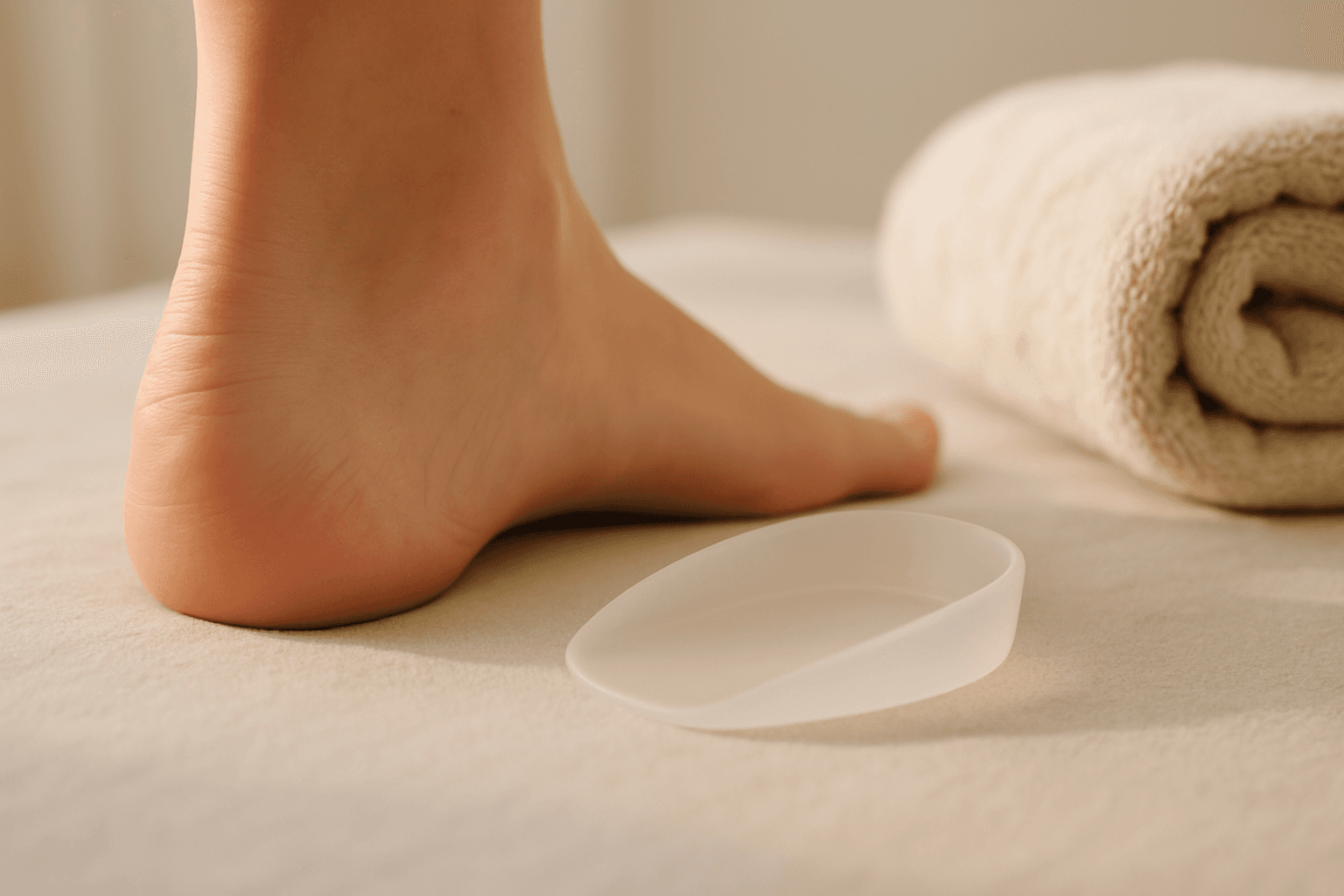
An aftermarket insole with a firm medial arch and a deep, cushioned heel cup is the highest-leverage upgrade you can make to the shoes you already own for a painful plantar-side spur. The firm arch unloads the fascia so its heel attachment is not being re-loaded with every step; the deep cup cradles the fat pad so it absorbs shock the way it was built to instead of squirting out sideways. The pair we would install first is in our Akusoli insoles review — the geometry matches the case for most readers with a plantar-side heel spur and any of the plantar fasciitis pain patterns.
For an Achilles-side spur at the back of the heel, the insole choice is different. A small heel lift or an insole with a slightly built-up rearfoot section takes tension off the tendon and reduces the pressure on the spur from below. Our heel cups vs insoles walk-through covers the two categories and when a plain heel cup is the more useful pick than a full insole.
Ease a new insole in over a week — a few hours the first two days, then a half day, then full days from day three or four. Feet coming from flat drugstore inserts often report a strange first-day feeling as the arch does work the muscles were compensating for; that fades. The insole lives in the shoes you wear the most hours in, not in a specialty pair in the closet. If your job puts you on your feet all day, the work boot or shift shoe is where the insole earns its money.
Rung three: shoes, socks and the daily load cut
Nearly every painful heel spur flare traces to a specific increase in load that tipped the surrounding tissue over the edge — a spike in mileage, a summer of flat sandals on hard floors, a new standing job on concrete, a fifteen-pound weight gain, a big trade-show week. Naming yours is often the fastest thing you can do, because a temporary cut in that specific trigger for two to four weeks lets the tissue calm down enough that the rest of the routine can catch up.
For a plantar-side spur, the shoes that matter are the ones you wear the most hours in — the work shoe, the walking shoe, the shoe you wear on longer errand days. Those need a firm heel counter, real arch support, torsional rigidity through the midfoot, and a moderate stack height. Our doctor-recommended shoes walk-through covers the features and how to test them in the store. Flat canvas sneakers, unstructured slip-ons, and worn-out running shoes past their mileage are the wrong home for a heel with a spur; save them for shorter days once the pain has been quiet for a month.
For an Achilles-side spur, the extra constraint is the shoe's heel counter — a stiff or tall counter that presses directly on the bony bump at the back of the heel is the daily aggravator. A shoe with a softer, lower or padded rear collar, or with an open back for house wear, is more comfortable through a flare. Some readers cut a small notch in an old pair of house slippers or add a felt donut around the bump to take the pressure off; that is a comfort move, not a treatment.
Rung four: ice, short-course NSAIDs and night splints
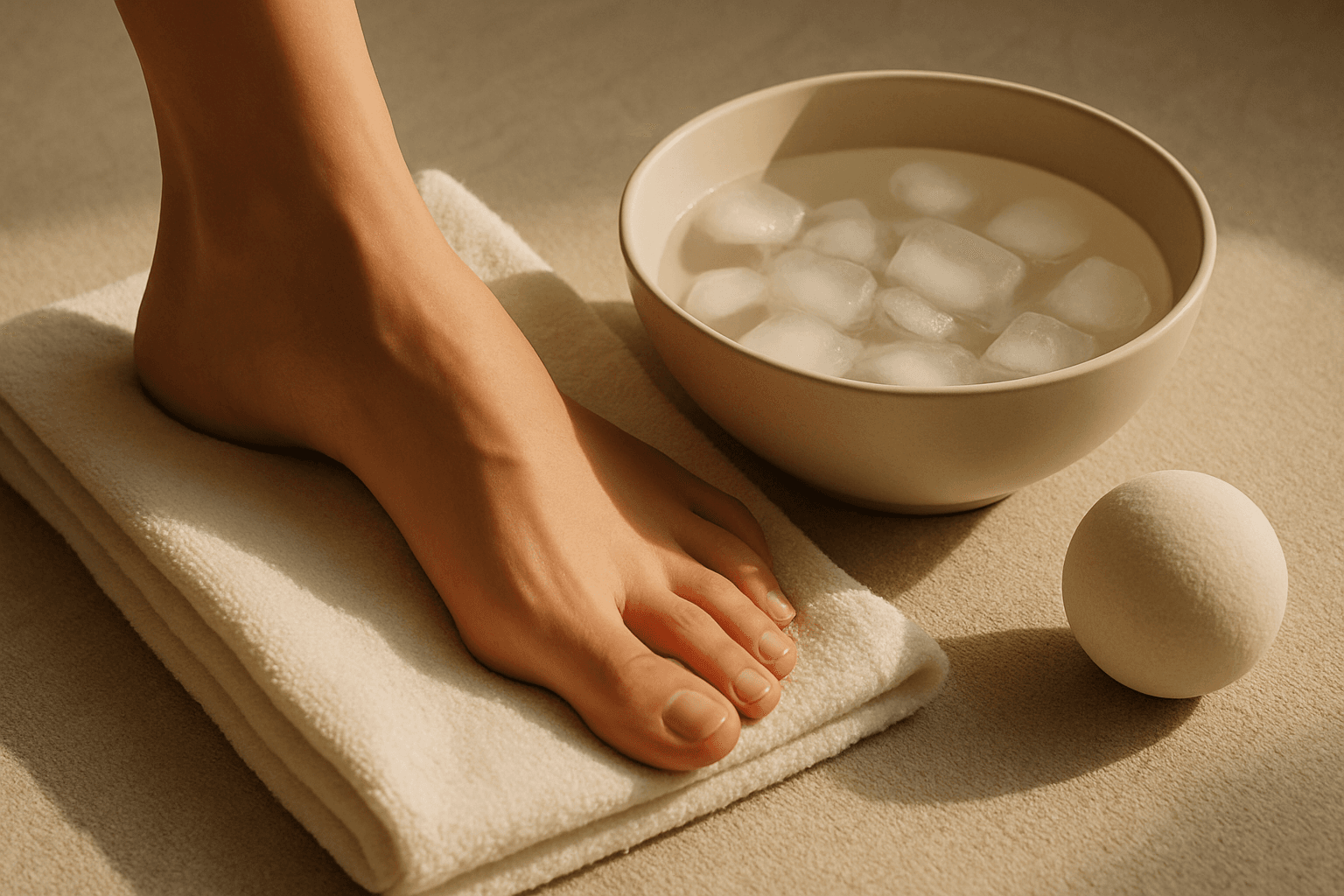
Icing after long days — a frozen water bottle under the arch for plantar-side spurs, an ice pack held at the back of the heel for Achilles-side spurs — is a comfort tool that blunts the evening flare and helps prevent the next morning's stab. Ten to fifteen minutes at the end of the day, not first thing in the morning. Morning tissue wants warming and lengthening, not cooling.
A short course of over-the-counter anti-inflammatories (ibuprofen, naproxen, taken for a defined week or two rather than daily indefinitely) can quiet an acute flare enough that the rest of the routine can catch up. Discuss with your primary care team before starting if you have kidney, stomach or blood-pressure concerns, are on other medications, or are pregnant. Long-term daily NSAID use for chronic heel pain with a spur is not the plan; it does not treat the underlying tissue and has real costs. Short course, defined end date.
A night splint holds the foot in a slight upward flex overnight so the plantar fascia does not spend eight hours in its shortened position. For plantar-side spurs with severe morning pain that has not settled with the daytime routine alone, two to four weeks of night splint use often produces a noticeable improvement. Not a first move, but a real tool for stubborn cases. Night splints for Achilles-side spurs are less commonly used and should be chosen with a clinician.
Rung five: physical therapy, taping and shockwave
Physical therapy is the highest-yield next step for a painful heel with a spur that has not improved after four to six weeks of an honest home routine. A good foot-and-ankle physical therapist will assess your gait, calf and hip strength, and specific fascia or Achilles loading, and build a program that goes beyond generic stretching into calf and intrinsic-foot strengthening — heel raises, short-foot exercises, single-leg balance, eccentric loading — that changes how the tissue tolerates load rather than just calming it down.
Low-Dye or arch-support taping applied by a physical therapist or athletic trainer is a cheap and reliable acute-flare tool for plantar-side spurs. The tape mechanically unloads the fascia for the day it is on and buys a window in which the underlying tissue can rest. Runners returning from a flare often use taping through the first few weeks of their comeback while strengthening catches up.
Extracorporeal shockwave therapy has the cleanest evidence base of the in-clinic modalities for chronic plantar fasciitis (and by extension, plantar-side heel spurs) that have not responded to earlier rungs. Multiple systematic reviews and randomized trials have found meaningful improvement in cases six months and older after a course of shockwave, and a Cochrane review notes moderate-quality evidence for its use. It is worth asking your physical therapist or podiatrist whether their clinic offers it if the pain has plateaued.
Rung six: injections, PRP and surgery
For chronic cases resistant to three to six months of consistent conservative care, a corticosteroid injection into the plantar fascia origin can settle stubborn soft-tissue inflammation and buy the earlier rungs of the ladder a chance to catch up. Injections are not a first move; done too early they can quiet a fascia that would have settled anyway, and repeated injections carry a small but real risk of fat pad atrophy and fascia rupture. One well-placed injection under ultrasound guidance is the more common modern approach. For Achilles-side spurs, corticosteroid injections into the Achilles tendon itself are generally avoided because of a documented tendon-rupture risk; peritendinous injections and other approaches are used with a specialist's read.
Platelet-rich plasma injections and other biologics have a growing evidence base for chronic plantar-side cases and are increasingly offered as an alternative to corticosteroids, particularly for readers concerned about the tissue effects of steroid injections. The evidence base is not yet as strong as for steroids, but it is improving and the side-effect profile is better. Ask your clinician what their local outcomes and options are.
Surgical removal of a heel spur is rare. It is reserved for pain that has resisted six to twelve months of honest conservative care with a clear soft-tissue target on imaging. Plantar-side surgery is typically a partial plantar fasciotomy — a release of the fascia at its attachment — often combined with a spur excision only if the spur is clearly involved. Back-of-heel surgery for a Haglund's deformity or a large insertional Achilles spur removes the bony bump and repairs the tendon insertion. Both operations have real recovery time (weeks in a boot, months to full activity) and real risks. Anyone considering surgery should have done a full course of physical therapy and at least one specialist consult first.
The honest expectation and when a spur is not the story
Most readers who follow a consistent conservative routine notice something in one to two weeks — the morning stab is less brutal for a plantar spur, the going-up-stairs sharpness is less pointed for an Achilles spur. Meaningful improvement in the walking-around, mid-day pain usually takes three to six weeks. Cases that started as short flares and were caught early can be nearly quiet at eight to twelve weeks. Cases that had been building for months, or that involve a bigger picture (heavy standing job, significant weight, a whole rotation of worn-out shoes), often take three to six months to settle. Nothing on this page shrinks the spur; the goal is to quiet the soft tissue around it.
A useful benchmark: if the pain is measurably better after two weeks of an honest daily routine, you are on the right trajectory and staying the course is the plan. If nothing has moved after four weeks, something in the routine is not working — most often the shoes are still wrong, the insole is not in the right pair, or the trigger activity has not actually been reduced. If nothing has moved after six weeks of honest work on the earlier rungs, a clinician earns their fee and physical therapy is the next step.
There is one more honest truth worth stating: about ten to fifteen percent of heel-spur cases do not fit a simple plantar-fascia or Achilles story. Inflammatory arthritis (reactive arthritis, ankylosing spondylitis, psoriatic arthritis) can inflame tendon attachments including at the heel; nerve entrapment can present as heel pain in the same location; and a small subset of cases involve a spur that has genuinely broken through into a sharp bone-injury picture. Any of those changes the plan. A podiatrist or foot-and-ankle clinician is the right person to sort the picture with you if the ladder above has been walked honestly and the pain is not moving. If months of consistent care have not been enough, our heel spur surgery guide explains when an operation is discussed and what it involves.
The supportive insole we would install for a painful heel spur
A trim-to-fit insole with a firm medial arch and a deep heel cup so the soft tissue around the spur is not being re-loaded with every step.
The supportive insole we would install for a painful heel spur →Frequently asked questions
Can a heel spur be treated without surgery?
Almost always, yes. Something like ninety percent of painful heel spurs settle with conservative care — a stretching routine morning and evening, a supportive insole with a firm arch and deep heel cup, better shoes with a firm heel counter, a temporary cut in whatever activity tipped the tissue over, and time. Surgery is reserved for the small minority of cases that have resisted six to twelve months of honest care with a clear soft-tissue target on imaging. If a clinician has recommended immediate surgery for a first painful heel spur without walking the conservative ladder, a second opinion is reasonable.
Does a heel spur ever go away on its own?
The pain around a heel spur often does; the bony spur itself typically does not shrink. Population imaging studies find heel spurs in one in five to one in ten adults, and the large majority have no pain — those are the spurs that never bothered anyone. When a painful spur becomes quiet with conservative care, the spur usually stays on X-ray unchanged while the inflamed soft tissue around it settles. That is the outcome most readers are actually after: not a change in the picture, but a change in how the foot feels through the day. The spur is downstream, not the cause.
What insole is best for a heel spur?
A firm-arch, deep-heel-cup insole for a plantar-side spur — the pair we would install first is in our Akusoli insoles review. The firm arch unloads the fascia so its heel attachment is not being re-loaded with every step, and the deep cup cradles the fat pad so it absorbs shock the way it was built to. For an Achilles-side spur at the back of the heel, a small three-to-six-millimeter heel lift is the more useful pick because it takes tension off the tendon; our heel cups vs insoles walk-through covers the two formats in detail. Ease any new insole in over a week.
How long does it take a heel spur to stop hurting?
For most readers doing a consistent conservative routine, meaningful improvement in the walking-around pain lands at three to six weeks, with cases resolving over three to six months. Cases that started as short flares and were caught early can be nearly quiet at eight to twelve weeks. Cases that had been building for months, or that involve heavy standing work or worn-out shoes across the whole rotation, often take six to twelve months to fully settle. The bony spur itself typically does not change on X-ray; what changes is the inflamed soft tissue around it.
Do cortisone injections work for heel spurs?
For plantar-side heel spurs with stubborn pain that has resisted three to six months of conservative care, a corticosteroid injection into the plantar fascia origin can settle soft-tissue inflammation for weeks to months. Injections are not a first move — done too early they can quiet a fascia that would have settled anyway, and repeated injections carry a small but real risk of fat pad atrophy and fascia rupture. One well-placed injection under ultrasound guidance alongside a real conservative routine has a place; a stack of injections in place of a routine does not. For Achilles-side spurs, corticosteroid injections into the tendon itself are generally avoided because of a documented tendon-rupture risk.
Can walking make a heel spur worse?
Walking on the tissue's terms, in a supportive shoe with a real insole, is part of the treatment — total rest usually makes the surrounding tissue stiffer and rebounds badly on the first return-to-load day. What makes a heel spur worse is walking in the wrong shoes (flat canvas sneakers, unstructured slip-ons, worn-out running shoes), on hard surfaces, at a load higher than the tissue can currently handle. The honest middle — reduced load, supportive setup, gradual return — is what the routine relies on. If walking has been consistently painful for weeks despite an honest routine, a clinician needs to look at the picture before the next step.
HeelCups is reader-supported. When you buy through links on our site we may earn an affiliate commission, at no extra cost to you. This article is general information about foot comfort and is not medical advice — see our medical disclaimer.