SELF-MASSAGE
Plantar Fasciitis Massage at Home: What Works, What Feels Good, and What to Skip
A ten-minute self-massage routine for the arch and calf, the tools worth owning, and the honest limits of massage as part of your recovery.
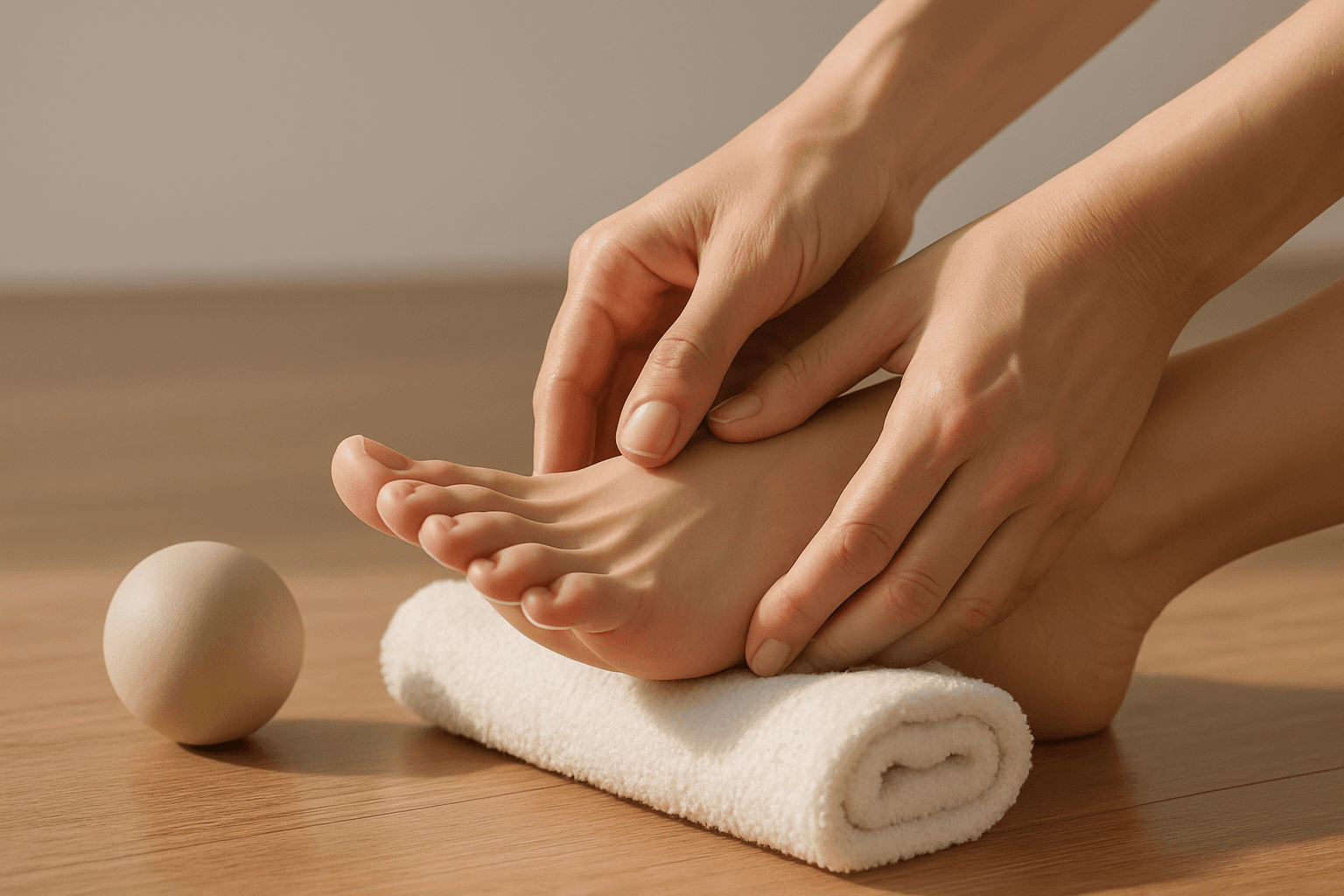
Self-massage will not fix plantar fasciitis on its own, but it belongs in the daily routine of anyone dealing with it. Rolling the arch between the ball of the foot and the front of the heel loosens the fascia along its length, calms the surrounding muscles and, for a lot of people, is the difference between a sore evening and a normal one. Add a few minutes on the calf and the effect compounds — a tight calf pulls tension right back into the fascia every time you take a step.
The gear is simple: a firm ball you can roll under your foot, a frozen water bottle for after long days, and your own thumbs. You do not need a percussion gun or a heated foot massager to get most of the benefit. What you do need is consistency — five to ten minutes twice a day for a few weeks.
As with everything on this hub, self-massage is a comfort and support tool, not medical treatment. Heel pain that has not budged after a month of honest home care, or pain that comes with swelling, numbness or an injury, is a signal to see a doctor or podiatrist rather than press harder. If pressing under your heel does not match the pattern most people describe with plantar fasciitis, our why does my heel hurt map is a better place to start.
What massage actually does for plantar fasciitis
The plantar fascia is a broad, ligament-like band that runs from the heel bone to the base of the toes and holds up the arch. When it is irritated it feels tight and tender, especially at its attachment on the heel. Rolling and kneading do not break up any 'scar tissue' — that framing is out of date — but they do increase blood flow to the tissue, reduce the guarded muscle tension that piles onto a sore fascia, and give the nervous system a strong non-painful input that turns down local pain signals for a while.
The practical version: after five minutes of arch rolling and calf kneading, the fascia is looser, the calves are less clenched, and your next steps land more evenly. Pair that with a supportive shoe or insole and the tissue gets a chance to calm down between sessions. Without the supportive footwear, you are basically pressing a reset button that gets un-pressed the moment you walk on a hard floor.
The daily ten-minute self-massage routine
Sit in a chair with the sore foot bare. Place a firm ball — a lacrosse ball, a dedicated foot-massage ball, or a tennis ball if that is what you have — under the arch. Roll slowly from the ball of the foot to just in front of the heel, pressing down as hard as feels good. Two to three minutes per foot. Slow beats fast; you are not trying to shred anything.
Move to the calf. Sit on the floor with the sore leg extended, place a firm foam roller or the same ball under the calf, cross the other leg over the top for extra pressure, and roll from the ankle to the back of the knee. Pause on the tight spots for five to ten seconds. Two minutes per side. Finish with thirty seconds of thumb pressure along the inside of the heel and the medial arch — the exact strip that hurts in the morning.
The frozen-bottle finish for after long days
Take a plastic water bottle, fill it three-quarters full, and freeze it flat. At the end of a long day on your feet, roll it slowly under the arch for five minutes. The cold gives an ice-massage effect that calms an irritated fascia; the firmness of the frozen bottle gives you the same mechanical loosening as a lacrosse ball.
This is the single most-recommended trick clinicians pass along, and it costs nothing. Keep two bottles in the freezer so one is always ready. Skin numbness after five minutes is normal; check-in longer than that is unnecessary.
Tools worth owning (and one to skip)
A dedicated firm foot massage ball with grippy nubs, a smooth lacrosse ball, and a basic foam roller are the whole kit for most people. Total spend under thirty dollars. A frozen water bottle you already have.
The tool most people ask about — a percussion massage gun on the arch — is not what we would prioritize. The vibration feels great and does no harm on the calf, but pressing a fast oscillating head onto the heel or the inflamed fascia often feels worse the next morning. If you own one, use it on the calves and skip the sole. A heated foot massager is comfort, not treatment; nothing wrong with using one, but do not let it replace the rolling.
How self-massage fits with stretching and support
Think of it as one third of the routine. Stretching lengthens the tissue, self-massage loosens it and the surrounding muscles, and a supportive insole and shoe stop overloading it between sessions. Any two of the three will help; all three is what tends to move the needle in a few weeks. Skip the arch support and you spend the whole day undoing the massage.
For the stretching half of the routine, see our plantar fasciitis stretches page. For the support half, the Akusoli insoles review is our first pick for the shoes you already own. The bigger picture, and how to tell plantar fasciitis apart from look-alikes, lives on the plantar fasciitis hub.
When to back off, and when to see a professional
Slight soreness after a session is normal; sharper heel pain the next morning is a sign you pressed too hard. Cut the pressure in half and try again. If a specific spot is exquisitely tender to any pressure, stop pressing directly on it and work around it — that kind of point tenderness is worth showing a clinician.
A licensed massage therapist or physical therapist can do things you cannot easily do to yourself — deep calf work, dry needling of the calf trigger points, hands-on fascia manipulation — and one or two sessions can sometimes unstick a stubborn case. Consider it if you are six weeks into a good home routine without progress, or sooner if pain is severe enough to change how you walk.
Add the support that makes the routine stick
A trim-to-fit insole with a firm arch and deep heel cup so the fascia is not being re-stretched all day between massage sessions.
Add the support that makes the routine stick →Frequently asked questions
How often should I massage plantar fasciitis?
Twice a day works for most people — a five-minute session in the morning and another after your last long stretch of standing or walking. Ten minutes in one session is the ceiling before returns diminish; splitting the time across the day is more comfortable and more effective.
Should plantar fasciitis massage hurt?
Firm and slightly uncomfortable is right; sharp or bruising is too much. If your foot is more sore the morning after a session, back off the pressure by half and shorten the time. The 'no pain, no gain' framing is wrong here — you are trying to calm an irritated tissue, not fight it.
Is a frozen water bottle actually as good as a fancy massage ball?
For the arch, yes, and often better because of the cold. The one thing a frozen bottle cannot do is get into the small muscles at the ball of the foot and the calf, where a firm ball or foam roller is easier to control. Owning both — a frozen bottle for the arch, a lacrosse or dedicated massage ball for everything else — is our recommendation.
Can I use a massage gun for plantar fasciitis?
On the calves, absolutely — light pressure, medium speed, two minutes per side. Directly on the sole and heel, we would not. The high-frequency vibration tends to leave the fascia sorer the next day. If yours has a soft ball or air head, that is safer than a bullet or fork attachment.
How long until I notice a difference from self-massage?
Most people feel an immediate short-term calm-down after the session — the fascia is looser, the calves let go. Sustained relief takes two to four weeks of daily practice paired with stretching and supportive shoes. If you are massaging into a flat, unsupportive insole all day, expect very slow progress.
Should I use a numbing cream or menthol rub before massage?
You can, but you do not need to. A menthol rub gives a cooling sensation that many people find soothing and does no harm; it is not treating the tissue in any meaningful way. Numbing creams remove the useful feedback that tells you when you are pressing too hard, which is why we would rather you skip them.
HeelCups is reader-supported. When you buy through links on our site we may earn an affiliate commission, at no extra cost to you. This article is general information about foot comfort and is not medical advice — see our medical disclaimer.