WALKING WITH PLANTAR FASCIITIS
Walking With Plantar Fasciitis: How Much Is Too Much, and When Does It Actually Help?
Walking sits in an awkward gray zone with plantar fasciitis — it is gentler than running but harder than sitting, and the right amount depends on the shoes, the surfaces and the day. Here is the honest decision tree, from the first-step morning stab to the full ten-thousand-step shift.
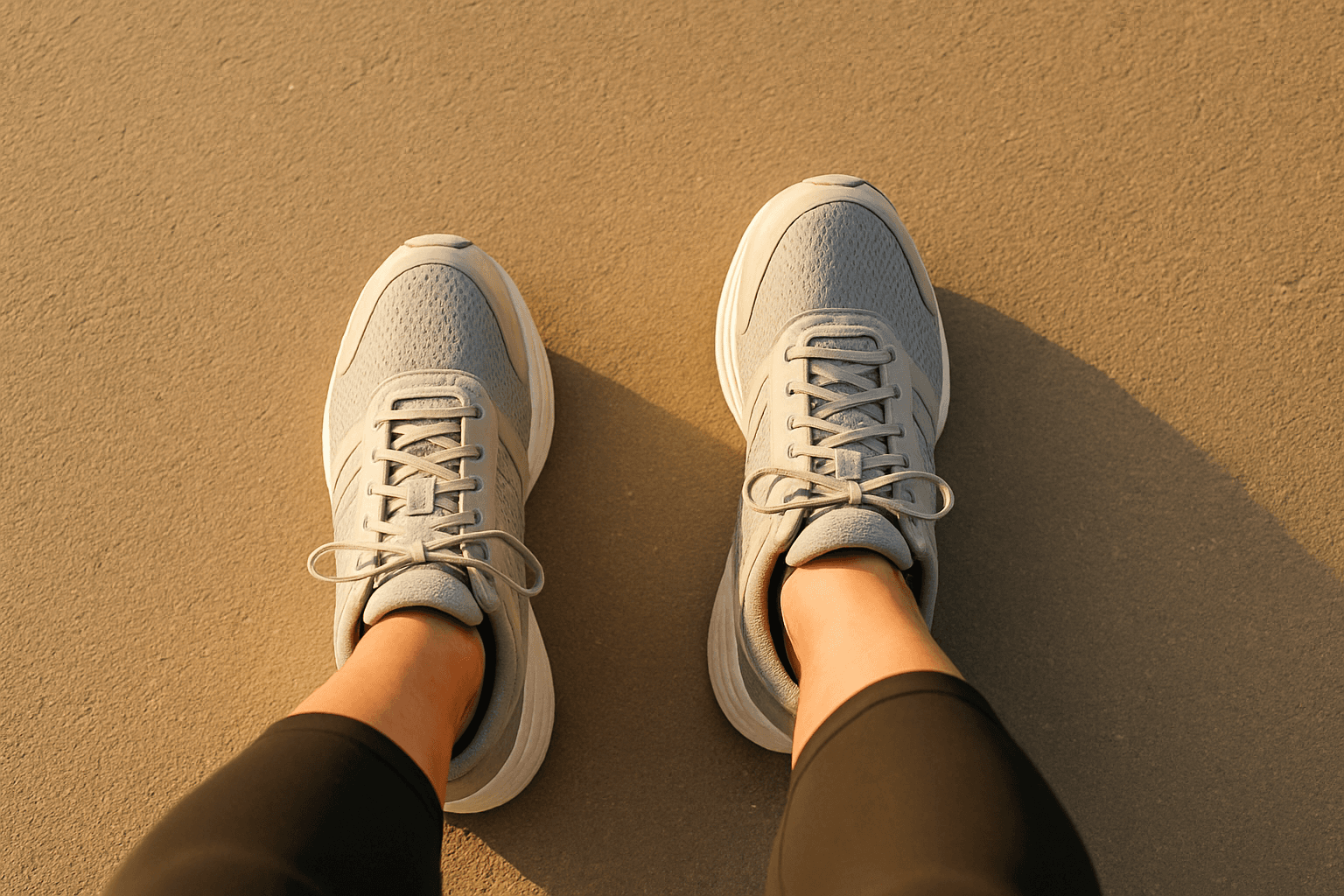
Walking is the exercise everyone recommends and the exercise that keeps lighting up a plantar fasciitis flare, often at the same time. A primary care doctor sends you out walking because it is low-impact and good for the rest of you. A physical therapist tells you walking is fine as long as the pain stays under control. A friend in the same forum thread says they walked through it and came out the other side. Another says walking is the single thing that keeps their heel from calming down. All four can be right, because walking with plantar fasciitis is less about the activity and more about the shoe on your foot, the floor under it, and how much standing time you have already banked that day.
The useful mental model is that plantar fasciitis is a loading problem, not a movement problem. The fascia does not care that walking looks gentler than running — it cares how many loading cycles went through it, at what intensity, with what support underneath. A barefoot shuffle across a tile kitchen can be harder on the tissue than a four-mile walk in a supportive shoe on a dirt trail. A long day on your feet at a trade show, broken up by a short lunchtime walk, can be the walk that gets blamed for the flare that the shift actually caused. This page is the honest walk-through of how to tell whether walking is helping, hurting, or neutral on any given day, and how to set the shoes, the surfaces and the schedule so walking is the comfort tool it is meant to be.
Nothing on this page is medical advice. Walking through persistent heel pain is a judgment call that is best made alongside a physical therapist, a sports medicine doctor or a podiatrist who has watched you move, especially if the pain has lasted more than four weeks. Every recommendation on this plantar fasciitis hub is written for relief, comfort and support — nothing on this site cures plantar fasciitis.
Why walking lives in the gray zone
Walking is gentler than running because the vertical ground reaction force is lower (roughly one and a half times body weight per step, versus two and a half to three for running) and because there is always a foot on the ground, so the fascia never catches the full airborne-plus-landing load. That is the case for walking. The case against walking is that most people walk far more than they run. A thirty-minute easy run is three thousand steps; a routine day on your feet is eight to twelve thousand. Over the course of a day, the cumulative fascia load from walking is almost always higher than it would be from a single run, and that is before standing still on hard floors (which adds load without the recovery that a step cycle gives the fascia) gets counted.
The second thing that makes walking awkward is that most of it happens in the shoes you are not thinking about. The run gets a dedicated running shoe; the walk gets whatever is by the door. Flat canvas sneakers, drugstore flip-flops, worn-out slip-ons and the house slippers you picked up on sale all show up on the walking foot and all share the same problem — no real medial arch structure, a soft heel pad that is already packed down, and a flat sole that puts the fascia at its longest at every mid-stance. The specific flat-sandal pattern is covered in our walk-through on flip-flops and plantar fasciitis and is one of the most reliable summer triggers we see.
The third thing is the floor. Walking on packed dirt or grass is kind to the fascia. Walking on polished concrete or warehouse flooring is not — the surface returns almost all of the impact to the foot, and the fascia takes a share of that return every step. For readers whose walking is mostly leisure-paced on soft surfaces, the walking itself is almost always comfort; for readers whose walking is a twelve-hour shift on hard floors, the walking is the problem that needs addressing before it can also be the therapy.
The daily walking traffic light
The same traffic-light rule most sports medicine clinicians use for running applies, in a milder form, to walking. Green: morning pain is a one or two out of ten and settles within a few minutes of walking. The planned walk is on; keep the full distance. Yellow: morning pain is a three or four, settles slowly, and the first ten minutes of a walk are a mild background ache that does not get worse as you warm up. The walk is on, cut distance by a third, keep the pace conversational, and stop short of any surface that feels like it is turning the ache up. Red: morning pain is a five or more, does not settle with the first steps, and gets worse within the first ten minutes of walking. The walk gets replaced by five minutes of indoor shuffling in supportive house shoes and a longer stretch session; serious walking waits for the next green or yellow day.
The second half of the rule is what the next morning looks like. A walk that was green or yellow on the check, but produced a sharper first-step stab the following morning, is a walk the fascia did not tolerate. Three next-morning-worse days in a row is the signal to cut daily step count by twenty to thirty percent and lean harder into the daily stretch routine, the between-walks shoe and the ice bottle. A walk that was yellow but left the next morning no worse than the one before is the walk the fascia tolerated, and it is the walk that keeps most people moving through a flare.
A useful piece of information for most readers is that step counts tend to lie in both directions during a flare. Phone pedometers underestimate the slow shuffling that keeps the fascia under constant low-grade load, and overestimate the fast-pace walking that recruits other muscles and spreads the load. The honest signal is not the number on the watch; it is how the next morning feels. If a long walk on soft surfaces at a brisk pace leaves tomorrow morning no worse, it was within tolerance regardless of what the counter said; if a short walk at a shuffle on hard floors made tomorrow morning sharper, it was too much.
The shoes you walk in matter more than the walk itself
The single highest-leverage change most readers can make is swapping the walking shoe. The features that matter are the same ones that matter in any supportive shoe: a firm medial arch structure that does not collapse under body weight, a deep heel cup that cradles the fat pad rather than letting it squirt sideways, a moderate heel-to-toe drop of eight to ten millimeters, and a rocker or stiff forefoot that reduces the amount of flex the fascia tolerates at toe-off. Our walk-through on doctor-recommended shoes for plantar fasciitis covers the specific categories and the ones to avoid.
The between-walks shoe matters at least as much. Readers with a well-chosen walking shoe but a flat drugstore flip-flop for the three-block coffee run almost always report a lingering flare that will not clear until the between-walks shoe gets the same scrutiny. The useful rule is that any time your feet are on their feet, the arch and heel cup should be doing the same job the walking shoe is doing. A supportive insole added to the shoes you already own is often the easier upgrade; our Akusoli insoles review is the trim-to-fit pair we would install in the between-walks shoe first.
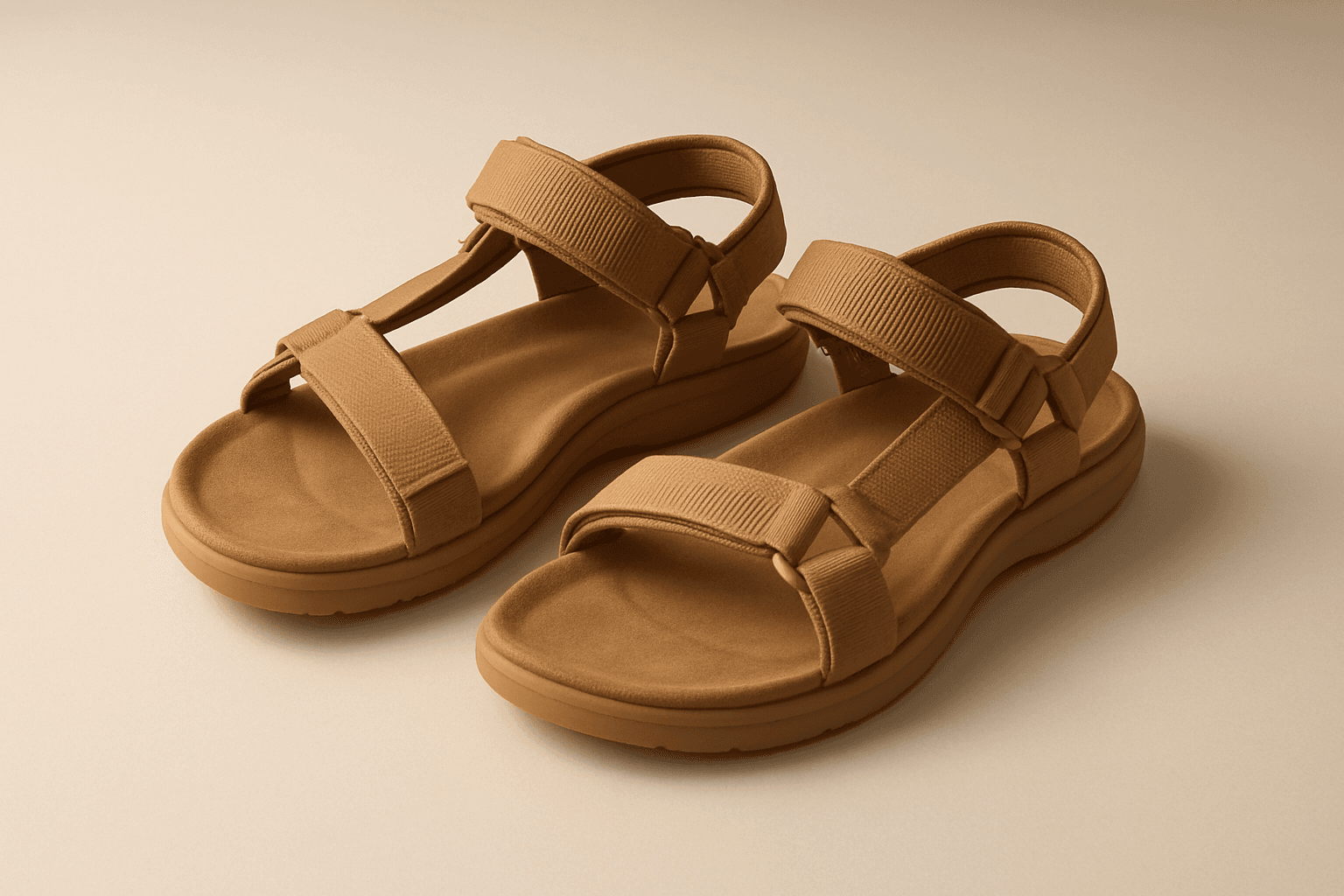
House time counts. Walking around a hard-floored kitchen barefoot before a morning walk is often why the first mile hurts; a supportive house slipper or a pair of recovery sandals with real arch structure, worn from the moment feet hit the floor until socks and shoes go on, is a small change that most readers notice within two or three days.
Pace, distance and surfaces that calm versus flare
A brisk, upright walking pace recruits the whole posterior chain — glutes, hamstrings, calves — and shares the load across more muscles than a slow shuffle does. The slow shuffle, counterintuitively, is often harder on the fascia because the longer stance phase keeps the arch under tension longer per step. For most readers who can tolerate it, a slightly faster conversational pace with a longer stride is kinder to the fascia than a drag-your-feet amble, as long as the shoe is supportive and the surface is reasonable.
Surfaces order themselves the same way they do for running. Packed dirt trails, crushed limestone paths, grass, treadmill belts and well-maintained walking paths are easiest on the fascia. Asphalt and concrete sidewalks are harder, and polished indoor concrete (warehouse, trade show, hospital) is the hardest common surface. A reader who moves half of their weekly walking volume onto the top three categories almost always sees the morning pain scale drop within two to three weeks without changing anything else. Sand is tempting but tricky — soft dry sand is a workout for every lower-leg muscle, which can both help (stronger supporting cast) and hurt (acute overload on tissue that is already irritated); the safer default during a flare is firm wet sand at the tide line, in supportive sandals, and short.
Distance is the last lever. Three short walks spread through the day load the fascia less than one long walk of the same total, because each sitting break lets the inflammatory signal settle. A reader with a flare who has to clock eight thousand steps a day for a step-count goal almost always does better splitting that into four two-thousand-step blocks than into one marathon evening walk. The ten-thousand-steps-a-day target is not a medical recommendation — it is a marketing number from a Japanese pedometer company in the nineteen-sixties — and no one needs to defend it against a healing fascia.
Barefoot time: the hidden walking that most people do not count
The walking that most readers underestimate is the barefoot shuffling around the house in the morning, the kitchen in the evening, and the bathroom at night. A fascia that was warmed up and comfortable during a supportive morning walk can be back at square one by lunchtime because of two hours of barefoot kitchen work on tile floors. The useful rule during an active flare is that bare feet on hard floors is the walking that costs the most and buys the least, and swapping it for a supportive house shoe or a recovery sandal is a change that pays back faster than almost anything else.
Carpet changes the math. A long carpet runner down a hallway or a rug in front of the kitchen sink can be enough to turn barefoot time at home into tolerable loading. For readers with mostly hard floors, a $20 anti-fatigue mat at the sink or stove is a worthwhile addition. For readers who already wear supportive house shoes, carpet is a bonus but not a requirement.
A short daily plantar fasciitis stretches routine, done before the first barefoot steps of the morning and after the last walking of the day, is the stretch pattern that most reliably moves the pain scale down in two to three weeks. Seated calf and fascia stretches done from the edge of the bed before weight goes onto the foot change the character of the first-step pain more than almost any other single intervention, and they cost two minutes.
When walking is the main movement, and when it has to pause
For most readers with early or mild plantar fasciitis, walking never fully stops; it changes. The daily walk gets the right shoe, moves to a kinder surface, cuts distance by twenty to thirty percent for two to three weeks, and runs underneath the daily stretch and insole routine. The feet feel better within a week or two in most cases, and walking returns to baseline inside a month or two. The reader who tries to walk a flare off without changing the shoe or the surface is the reader who ends up on this page six weeks later still frustrated — walking is the right medicine when it is dosed and delivered right, and the wrong medicine when it is just more of the same thing that lit the flare up.
Three patterns are reasons to pause meaningful walking until a clinician reads the foot. The first is pain that keeps climbing week over week despite a load cut, honest stretching and a supportive shoe — a fascia that is not responding to conservative care is a fascia that may have moved into territory that needs a formal physical therapy course or a specialist conversation. The second is a sharp pop or sudden sharp pain under the heel during a walk, especially if a corticosteroid injection has been given in the last two months — plantar fascia rupture is uncommon but real and needs an in-person exam within a few days. The third is pain that spreads outside the fascia pattern (into the ankle, the top of the foot, the Achilles, or up the leg) or pain that comes with swelling, warmth, numbness, tingling, color change, or night pain that wakes you — these patterns are not plantar fasciitis and need a clinician.
Persistent heel pain that has not eased after four to six weeks of honest home care deserves an in-person exam by a doctor or podiatrist. Nothing on this site cures a foot condition, and nothing here replaces medical advice — the goal is comfort, support and relief while the fascia calms down, and the knowledge of when the picture has stopped fitting the self-care lane.
Add the support that lets the walking earn its keep
A trim-to-fit insole with a firm medial arch and a deep heel cup, so the fascia is not being re-stretched between every walk and the hours in between.
Add the support that lets the walking earn its keep →Frequently asked questions
Is walking good for plantar fasciitis?
In the right shoes, on the right surface, in the right amount — yes. Walking is low-impact aerobic movement that keeps the calf-and-Achilles complex loose, supports healthy circulation to the healing tissue, and reinforces the daily rhythm that most recoveries are built around. In unsupportive shoes, on hard concrete, for a full ten-hour shift with no breaks — walking becomes a daily reload of the irritation and keeps a flare going for months. The honest answer is not yes or no; it is "it depends on how it is dosed and delivered." Change the shoe, pick kinder surfaces, split the volume into shorter blocks, and run the daily stretch and insole routine underneath, and walking usually earns its keep.
How much should I walk with plantar fasciitis?
During an active flare, cut daily step count by twenty to thirty percent from your usual baseline for two to three weeks, then rebuild in ten-percent weekly increments as the morning pain scale drops. Three short walking blocks spread through the day load the fascia less than one long block of the same total, because each sitting break lets the inflammatory signal settle. There is no universal mileage target; the honest signal is how the next morning feels. Any walk that leaves tomorrow morning no worse than today was within tolerance.
Can I still hit 10,000 steps a day with plantar fasciitis?
You can, but it is almost never the right target during an active flare. The ten-thousand-steps number is a marketing figure from a nineteen-sixties pedometer campaign, not a medical recommendation, and defending it against a healing fascia is a bad trade. Six to eight thousand steps spread across the day, in a supportive shoe, on softer surfaces, is more useful to most people in the first few weeks. Once the morning pain scale has been under three out of ten for two weeks, step count can rebuild in weekly increments without flaring the tissue.
What is the best walking shoe for plantar fasciitis?
The shoe you want has a firm medial arch structure that does not collapse under body weight, a deep heel cup that cradles the fat pad, a moderate heel-to-toe drop around eight to ten millimeters, and a rocker or stiff forefoot that reduces fascia flex at toe-off. Most structured-cushion walking shoes and daily running trainers meet all four; most minimalist, zero-drop and flat canvas shoes meet none. The between-walks shoe — the one on your foot for the sixteen hours you are not out walking — matters at least as much as the walking shoe, and that is usually where a supportive insole makes the biggest comfort difference.
Is walking barefoot bad for plantar fasciitis?
On hard indoor floors, during an active flare, almost always yes. Barefoot shuffling on tile, hardwood or polished concrete is one of the single most reliable triggers for a flare that will not calm down, because the fascia is at its longest stretch at every mid-stance and the heel pad gets no cushioning. Swap it for a supportive house shoe or a recovery sandal with real arch structure, worn from the moment feet hit the floor in the morning. Barefoot on soft grass, warm firm sand, or a thick carpet is a different story and is usually fine in short doses once the flare has settled.
Can walking actually help plantar fasciitis heal, or does it just not make it worse?
Honest answer: walking is a comfort and support tool, not a cure. Short, supportive walks on kinder surfaces help the fascia tolerate load, keep the calves loose, support circulation, and make the daily stretch and insole routine easier to stick with — all of which are part of why most cases settle with conservative care over weeks to months. Walking is not what resolves the irritation; the daily stretch routine, the supportive shoe, the between-walks insole and the activity cuts are what do. Walking is what keeps you moving and comfortable while they do their work. Persistent pain that has not eased after four to six weeks of honest home care deserves an in-person exam by a doctor or podiatrist.
HeelCups is reader-supported. When you buy through links on our site we may earn an affiliate commission, at no extra cost to you. This article is general information about foot comfort and is not medical advice — see our medical disclaimer.