SYMPTOMS
Plantar Fasciitis Symptoms: How to Tell It From Every Other Kind of Heel Pain
The stabbing first-step pain in the morning is the classic tell, but plantar fasciitis has a whole map of symptoms — where it hurts, when it hurts, and what makes it worse. Here is how to read yours against the conditions that mimic it.
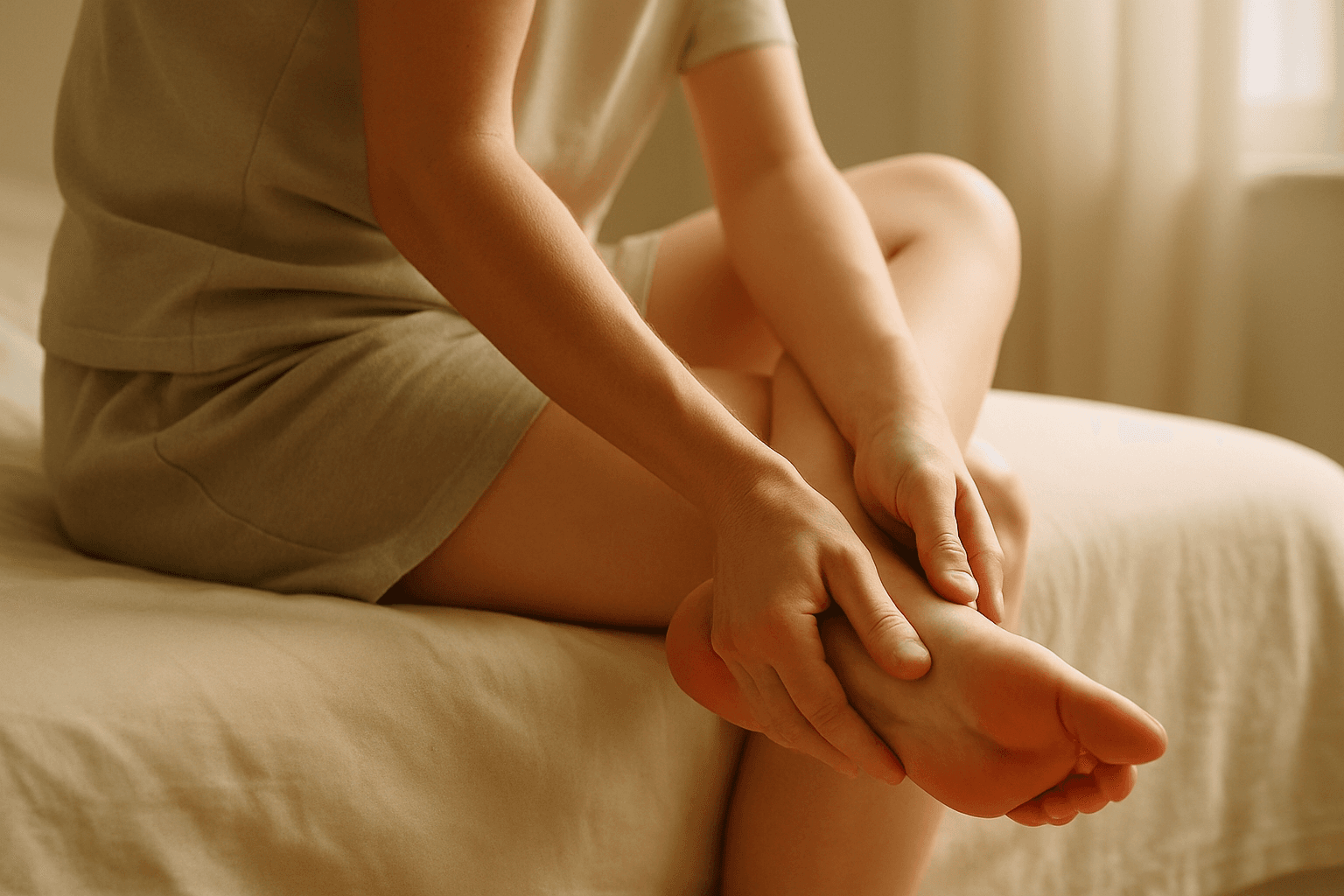
Plantar fasciitis has a distinctive symptom pattern once you know what you are looking for. Sharp, stabbing pain right under the front of the heel bone with the first steps in the morning, or after any long sit — that is the flagship. The pain eases as you walk on it, only to come creeping back at the end of a long day. Press with your thumb on the underside of the heel where it meets the arch, and you will find a tender spot that feels like a small bruise but is really the inflamed origin of the plantar fascia. Pain that fits this map, in an adult who has recently ramped up standing, walking or running, is plantar fasciitis until proven otherwise.
The reason symptoms matter is that the conditions that share the neighborhood — Achilles tendinopathy at the back of the heel, a fat pad problem across the whole heel pad, a stress fracture in the heel bone, Sever's disease in children and teenagers, tarsal tunnel syndrome, even reactive arthritis — all respond to different care. Load a plantar fasciitis routine onto Achilles pain and you can make it worse. Cushion a stress fracture and it will still be fractured in six weeks. So spending five minutes to match your specific symptoms against the map below is not medical hair-splitting; it is the difference between a plan that works and a plan that wastes a month.
This page walks the symptom map, the mimic conditions worth ruling out, the red flags that mean skip the self-care and see a clinician, and the specific tests you can do at home to increase the odds you have read your own foot correctly. Nothing here is medical advice, and this is not a diagnosis. Persistent heel pain that has not eased after four to six weeks of honest home care deserves an in-person exam by a doctor or podiatrist. Every recommendation on this hub is written for comfort, support and relief.
The classic plantar fasciitis symptom pattern
The single most reliable feature of plantar fasciitis is what clinicians call "post-static dyskinesia" — pain that is at its worst the first few steps after being off your feet for a while, then eases as the fascia warms up. In practice that means: the first steps out of bed in the morning, the first steps after a long sit at your desk, the first steps after a car ride, the first steps after a movie. Each of those transitions restarts the pattern. That is not how a bone problem or a nerve problem behaves. Bone pain hurts on every weight-bearing step; nerve pain hurts unpredictably and often at night. A pain that stabs on the first step and settles after a block is fascia.
The pain lives at a specific spot: the underside of the heel bone, right where the front of the heel meets the arch (the medial calcaneal tuberosity, if you want the anatomical term). Press with your thumb on the sole of your foot half an inch forward of the very back of the heel, on the inside edge. If there is a small, focal tender spot that is more sore than the rest of the heel, that is the plantar fascia origin. Diffuse tenderness across the whole heel pad is not plantar fasciitis; it is more consistent with fat pad irritation.
Character matters too. Plantar fasciitis pain is stabbing or bruise-like on the first step and dull-achey through the day. It rarely radiates far — a little into the arch, sometimes toward the ball of the foot, but not up the calf or across the ankle. Pain that shoots up the calf, or that comes with tingling into the toes, is not the fascia; it is more consistent with a nerve entrapment. Pain that burns and gets worse at rest is not the fascia either.
How the symptoms change through the day and through the weeks
A typical plantar fasciitis day starts rough and settles by mid-morning. Ten to twenty steps of gentle walking is usually enough to move the pain from a stabbing eight out of ten to a background two or three. Long standing (twelve-hour shifts, a full day at the trade show, an afternoon of shopping on concrete) drives the pain back up. Sitting for an hour and then standing restarts the first-step pattern, though usually less brutally than the morning re-boot. Evening is often the second-worst window of the day, after a full day of accumulated load. This morning-eases-then-evening-worst rhythm is the fingerprint.
Over weeks, an untreated fascia typically follows one of two arcs: it very slowly settles as long as the trigger (a spike in mileage, a new job, a summer of sandals) is removed, or it plateaus at a low-grade daily annoyance that does not go away on its own. About eighty to ninety percent of cases resolve within six to twelve months of conservative care in the published outcome studies — the range depends on how honest the daily routine is. Cases that are still bad at three to six months with a real routine belong with a clinician for a fuller work-up.
One useful signal: if your "plantar fasciitis" has been perfectly steady in intensity for three months, neither better nor worse, and none of the standard changes have moved it, it may not actually be plantar fasciitis. Fascia responds to load changes. Something that does not respond at all to load changes is worth a second look at whether the diagnosis is right.
The conditions that mimic plantar fasciitis, and how to tell them apart
Fat pad syndrome is the mimic most often mistaken for plantar fasciitis. The pain is across the whole heel pad, not focal at the front of the heel bone, and it feels more like a bruise than a stab. It does not follow the morning-worst pattern as tightly, and it is worst late in the day rather than first thing. It responds to cushioning (a gel heel cup, a thick sock, a padded insole) more than to arch support. If your "plantar fasciitis" gets worse in a shoe with more arch support and better in a shoe with a squishy heel, you may have a fat pad problem instead.
A calcaneal stress fracture is the mimic that must not be missed. The pain is deep, focal, and hurts on every weight-bearing step — not just the first one. It usually followed a specific event: a spike in running mileage, a jump from a height, an aggressive return from injury. Squeezing the sides of the heel bone with your thumb and finger (a lateral compression test) usually reproduces the pain. Stress fractures need imaging and typically a period of protected weight-bearing; they do not respond to insoles and stretches, and they can worsen if you push through them. Any deep heel pain that hurts on every step, especially with a recent activity spike, deserves a clinician's read before you self-treat.
Achilles tendinopathy is a different beast entirely. The pain is at the back of the heel — either at the insertion where the tendon meets the heel bone (insertional) or two to six centimeters up the tendon (mid-portion) — not underneath. It hurts going up stairs and on hills, gets worse with aggressive stretching in the acute phase, and responds to a small heel lift plus eccentric calf loading rather than to arch support. Our pain in the back of the heel walk-through covers the Achilles patterns in detail. If your "plantar fasciitis" hurts at the back of the heel rather than underneath it, you are looking at the wrong page.
Tarsal tunnel syndrome — a nerve entrapment on the inside of the ankle — sometimes presents as heel pain with a burning, tingling or electric quality that can radiate into the sole and toes. It often gets worse at rest and at night, which is the opposite of a fascia. If your symptoms have any of those neurological features, a clinician needs to work it up rather than a stretching routine.
In children and teenagers, persistent heel pain is almost never plantar fasciitis. Sever's disease — a growth-plate irritation at the back of the heel bone — is far more common in active kids aged eight to fourteen, and it needs a different plan. Adult plantar fasciitis symptoms in a growing foot should go to a pediatric podiatrist or sports medicine clinician, not into an adult routine.
Red-flag symptoms that mean skip the self-care
Pain that wakes you at night, or that comes with numbness, tingling, burning, or a color change in the foot, is not the self-care lane. Nerve entrapment, peripheral neuropathy, complex regional pain syndrome and vascular problems can all present as heel-pain-plus-something-else, and each needs a different clinician's work-up. Diabetic readers with new heel pain or any foot sensation change should reach out to their primary care team quickly, because sensation and circulation are altered by the disease and the usual self-check-in signals are less reliable.
Swelling, warmth, redness or a hot patch on the heel or ankle is a same-week clinic visit at minimum. Infection, deep vein thrombosis and inflammatory arthritis can all look this way, and none of them are fascia. Fever with foot pain is an emergency-department picture until proven otherwise.
Pain that started with a specific injury — a fall, a jump, a heavy object landing on the foot — should be imaged before it is treated as fascia. Fractures of the heel bone, stress reactions, and soft-tissue tears can all hide as "plantar fasciitis" that does not respond to a routine.
Bilateral heel pain in a younger adult, morning stiffness that lasts more than an hour rather than a few minutes, or heel pain alongside joint pain in other parts of the body raises the possibility of an inflammatory arthritis (reactive arthritis, ankylosing spondylitis, psoriatic arthritis). These conditions inflame tendon attachments including the plantar fascia and Achilles insertion, and they belong with a rheumatologist for the full picture.
Home tests to increase the odds you have read your foot correctly
The Windlass test is the classic at-home fascia check. Sit with your leg extended and use one hand to pull your big toe up toward your shin as far as it will go while the other hand rests on the underside of the arch. You should feel the fascia go taut like a bowstring under the arch. Pain reproduced along the underside of the arch with this maneuver is a positive finding for plantar fasciitis. A clean pull with no pain does not rule it out; a painful pull reinforces the diagnosis.
The thumb-press test we already covered — press with your thumb on the underside of the heel about half an inch forward of the very back, on the inside edge — is what podiatrists use in the clinic. Reproduction of your usual pain right at that spot is a strong hint at plantar fasciitis. Reproduction of pain across the whole heel pad points toward fat pad. Reproduction of pain on the sides of the heel bone points toward a stress fracture. Reproduction of pain up the Achilles points toward tendinopathy.
The first-step test is what most readers do on their own the morning they suspect fascia. Note where the pain is worst on your very first weight-bearing step. Under the heel toward the arch is fascia. Across the whole heel pad is fat pad. At the back of the heel is Achilles. Deep and focal that hurts on every step is a fracture-flavored picture. Track the answer for three mornings in a row — a single data point is easier to misread than a small pattern.
When symptoms fit the map, and what to do next
If your pattern fits — first-step morning pain that eases with walking, a tender spot at the front-inside of the heel bone, no red flags, no injury history, and a plausible trigger like a spike in standing or running mileage — the self-care lane is where to start. The plantar fasciitis stretches routine morning and night, a supportive insole with a firm medial arch and a deep heel cup in every shoe you wear all day (the Akusoli insoles we would install first), and a temporary cut in whatever activity tipped the fascia over are the honest starting three. Our full plantar fasciitis treatment walk-through steps through the ladder from home care to injections in more detail.
Give the routine three to four weeks before deciding it is not working. The fascia does not calm down in a day, and one honest week of the routine will not overturn a three-month accumulation of load. If the pattern has not improved noticeably in six weeks of daily practice, or has plateaued at a low grade that will not budge, that is when a clinician (a primary care physician, a podiatrist, or a foot-and-ankle sports medicine specialist) earns their fee. Physical therapy is the highest-yield next step for most readers.
If your symptoms did not fit the fascia map above, work through our why does my heel hurt walk-through and then follow the pillar sub-page for the specific pattern you land on. The wrong routine for the wrong problem is not just wasted time; it can make things worse. And any red flag from the section above deserves a clinician's read before any home routine, however sensible.
The full plantar fasciitis treatment walk-through
Once you have mapped the symptoms to the fascia, the treatment ladder from home care to injections is the natural next read.
The full plantar fasciitis treatment walk-through →Frequently asked questions
How do I know if my heel pain is plantar fasciitis or something else?
The clearest tell is the pattern: sharp pain in the first steps of the morning that eases as you walk, a focal tender spot at the front-inside of the heel bone under the arch, and pain that flares again at the end of a long day on your feet. Diffuse pain across the whole heel pad is more consistent with fat pad irritation; pain at the back of the heel points at the Achilles; deep pain that hurts on every step, especially after a recent activity spike, is worth ruling out a stress fracture before you self-treat. The Windlass test (pulling the big toe back and checking whether it reproduces arch pain) is a useful home check for fascia specifically.
Does plantar fasciitis pain go away on its own?
Most cases settle over six to twelve months with a consistent routine of stretching, supportive footwear and a temporary reduction in whatever triggered the flare. About eighty to ninety percent of readers who stick with an honest routine feel meaningfully better within a few months; the remaining minority need physical therapy, a night splint, or a clinician-supervised step up the treatment ladder. Cases that are still bad at three to six months with a real routine belong with a doctor or podiatrist, not with more DIY.
Why is plantar fasciitis worse in the morning?
The plantar fascia shortens slightly overnight while you are off your feet, and it also carries the low-grade inflammation from the previous day's use. The first steps in the morning yank that shortened, irritated tissue taut suddenly, which is exactly the mechanism a bruise reacts badly to. After ten or twenty steps the fascia has warmed and lengthened enough that the pain settles. The same restart happens after any long sit — that is why the first steps after a car ride or a movie so often mimic the morning pattern. The most useful counter-move is a gentle towel or belt stretch in bed before your feet touch the floor.
Can plantar fasciitis cause pain in both feet at once?
It can, though it is a little less common. Bilateral plantar fasciitis often shows up in people whose whole-body load has changed — significant weight gain, a new standing job, pregnancy, or a summer of flat sandals on hard floors. When both heels start hurting at the same time, especially in a younger adult with morning stiffness that lasts more than an hour or joint pain elsewhere, an inflammatory arthritis like reactive arthritis or ankylosing spondylitis is worth ruling out with a doctor. Simple bilateral fascia in a middle-aged reader with an obvious trigger is common; bilateral fascia in a younger reader with no obvious trigger deserves a fuller work-up.
Is it plantar fasciitis if my heel does not hurt in the morning?
Probably not in the classic sense. The morning-worst pattern is the strongest single symptom, and cases without it are more often mimic conditions — a fat pad problem, an Achilles issue, a stress fracture, or a nerve entrapment — dressed up as "plantar fasciitis." A chronic fascia that has been present for a year can lose some of its morning bite as the tissue thickens, but by then the diagnosis has usually already been made. New heel pain that hurts all day evenly, without the first-step spike, is worth mapping against the mimic conditions above before you start a fascia routine.
Do plantar fasciitis symptoms include arch pain?
Yes, often — a moderate case commonly aches along the underside of the arch as well as under the heel, and pulling the big toe upward tends to reproduce the arch pain because it tensions the whole fascia. Pain that stays purely in the arch and never involves the heel is less typical and worth ruling out an arch strain, a tendon problem or (rarely) a mid-foot stress fracture with a clinician. Arch soreness at the end of long days is very common in early plantar fasciitis and often responds to the same stretching and supportive insole routine the heel does.
HeelCups is reader-supported. When you buy through links on our site we may earn an affiliate commission, at no extra cost to you. This article is general information about foot comfort and is not medical advice — see our medical disclaimer.