HEATED SOCKS
Heated Socks for Cold Feet: What They Actually Do, When They Help, and How to Pick a Pair
Battery-heated socks are a comfort tool, not a medical treatment. Used at low sustained warmth they beat any space heater aimed at your ankles — here is when they are worth the spend, and what to check before buying.
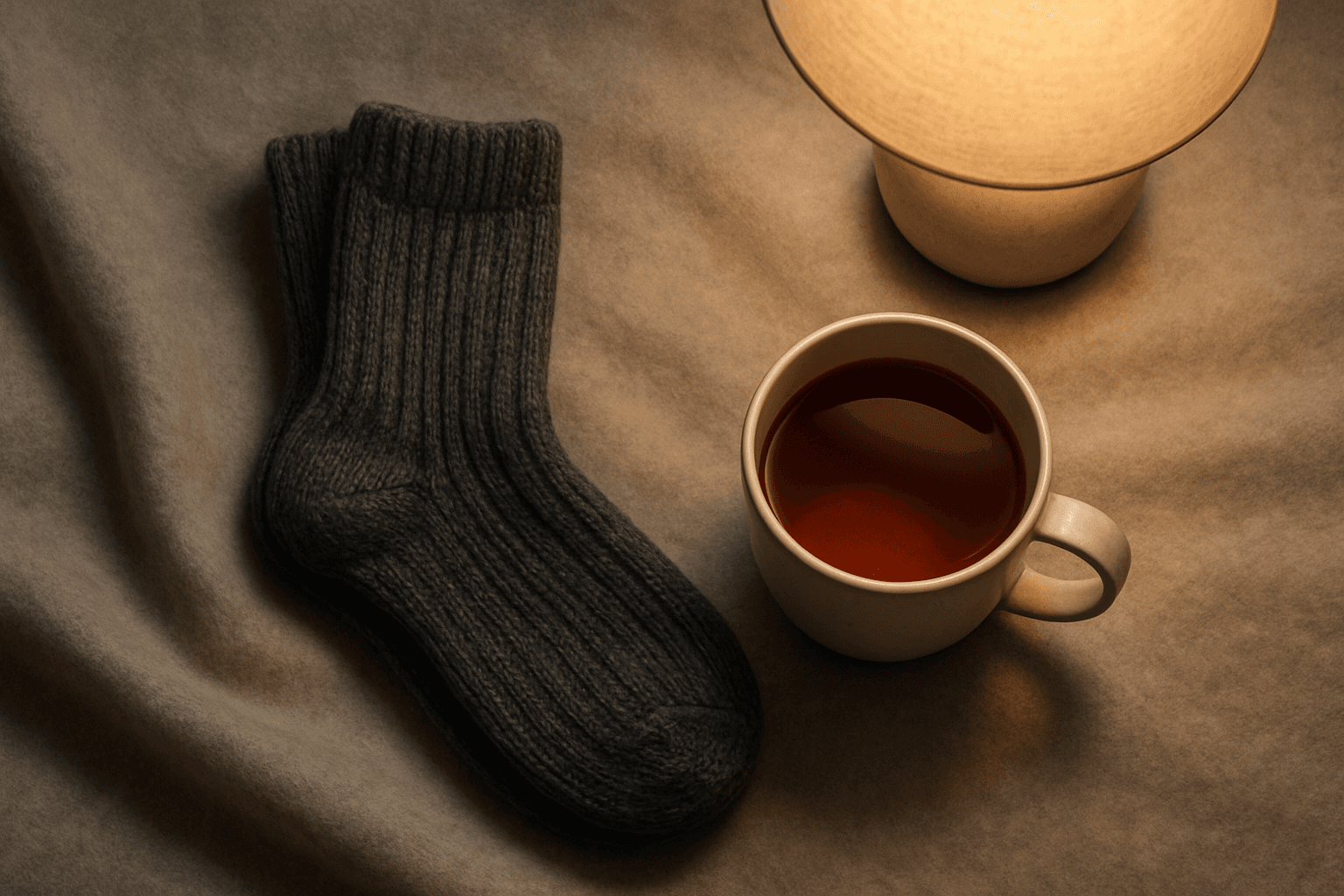
Heated socks are marketed almost entirely to the outdoor crowd — hunters in tree stands, skiers on cold chairlifts, ice-fishing anglers. That marketing sells the peak-warmth setting on a photograph of snow, which is honest for a Saturday in the woods and misleading for the much bigger group who quietly buys them: people whose feet are simply always cold at home. On a low, sustained setting for an evening at a desk or on the couch, a good pair of battery-heated socks does exactly the job people wanted a space heater aimed at their ankles to do, without cooking the rest of the room.
Heated socks do one thing at the tissue level: they warm the skin of the foot and, over minutes, the small vessels underneath it. Warmed vessels dilate and blood flow to the foot increases, which is the comfort a cold foot has been looking for. That is worth being precise about — heated socks do not treat any medical condition. They are a comfort tool for the ordinary experience of cold feet in a cold room, and for the specific edge cases where a person's cold feet are a persistent complaint without a medical driver worth working up. Cold feet that come with numbness, color change, pain at rest or a one-sided pattern are a clinician's problem, not a foot-care aisle problem.
This page covers when a heated sock is the right tool, when a thick wool sock and a warm insole cover the same ground for less, and what actually matters when you compare pairs. Nothing here is medical advice. Persistent cold feet with any of the warning signs above deserve an in-person exam by a doctor. Every recommendation on this hub is written for comfort, support and relief.
Battery-heated vs. thermal (wool + a warm insole)
The honest first question before buying heated socks is whether a thermal sock plus a warm insole would solve the same problem for a quarter of the cost. A merino wool or wool-blend sock in the 200 to 400 gram weight range, paired with a felted or wool-topped insole inside a well-fitting shoe, keeps a lot of feet warm through an average cold house without a battery in sight. For anyone whose cold feet are mostly about a chilly bedroom and a wood floor, this is the pair we would try first; the cost is under thirty dollars and there is nothing to charge.
Battery-heated socks earn their price when thermal insulation alone is not enough. Feet that are cold even in a thick wool sock, feet that stay cold for hours after coming inside from a winter walk, and feet that need direct warmth rather than trapped warmth are the cases where the battery makes a real difference. The heating element (usually a thin wire woven along the arch, the top of the foot, or across the toes) puts warmth directly into the skin, which raises local temperature faster than any amount of insulation. The trade-off is real: batteries add weight and bulk, run time is finite, and the socks themselves cost several times what a wool pair does.
What actually matters when comparing heated socks
Watt draw and battery capacity together determine run time at each heat setting, and this is the specification most heavily fudged in marketing copy. A honest way to compare pairs: divide the battery capacity (in watt-hours, or milliamp-hours times voltage divided by a thousand) by the sock's watt draw at each setting. A pair with a 2,400 mAh 7.4V battery (about 17.8 watt-hours) and a low setting drawing 2 watts will run for roughly nine hours on low; the same battery on a high setting drawing 8 watts will last about two. The marketing photo showing eight hours of warmth is nearly always about the lowest setting, and the lowest setting is often the one you actually want for indoor use anyway.
Number of heat settings matters more than peak temperature. A pair with three or four settings gives you a genuinely usable low that you can wear for a whole evening; a pair with only high and off tends to be uncomfortably hot within twenty minutes. Look for the ability to fine-tune. Placement of the heating element is the next thing to check: elements across the top of the toes warm where cold shows up first, elements along the arch spread warmth more evenly through the foot, and elements on the back of the calf are useless for cold-feet complaints. Read the diagram, not the copy.
Fit and sock height determine both comfort and where the battery pack sits. A crew or knee-high sock puts the battery high on the calf where it will not press into a shoe, and it is the usable geometry for indoor wear. Ankle-height heated socks with the battery near the ankle are marketed for boots but tend to bunch under laces. Fabric matters too: a merino or merino-blend upper is more comfortable for a full evening's wear than pure synthetic, though pure synthetic dries faster and holds up better to outdoor abuse. Machine washability is now standard; still worth confirming before buying.
How hot should heated socks actually get
Skin can be safely warmed to about forty to forty-two degrees Celsius (one-oh-four to one-oh-eight Fahrenheit) for extended periods without burn risk in a person with normal sensation. Well-made heated socks stay well inside that range on their low and medium settings; the high setting on some pairs pushes closer to that upper bound and is not meant for hours of continuous wear. If you have ever caught a sock feeling almost too hot to keep on, that is not a design goal — that is the high setting doing what a high setting does, and the fix is a lower setting for longer.
For an evening at a desk or on the couch, level one is usually plenty. Level two or three is for the first fifteen to thirty minutes of warming up after coming inside from a cold walk, before dropping to level one for the rest of the session. Peak-heat marketing photos are honest for a Saturday in a hunting blind at minus ten Celsius; they are not the setting you want indoors. Users with any reduced sensation in the feet (see the next section) should stick to the lowest setting only and check the skin during and after use.
When heated socks are the wrong tool
Heated socks are not a treatment for Raynaud's phenomenon, peripheral neuropathy, peripheral arterial disease, or any circulatory or nerve condition, and they are actively risky in a few of those. Reduced sensation in the feet (from diabetes-related neuropathy, chemotherapy-induced neuropathy, or any other cause) means the usual signal that a sock is getting too hot may not arrive; burns from heated socks in patients with neuropathy are a documented and preventable injury. Anyone with any degree of neuropathy in the feet should either skip heated socks or use only the lowest setting with active skin checks, and preferably clear it with their clinician first.
Raynaud's phenomenon — episodes of small vessel constriction that turn fingers or toes white, blue, then red — is real cold and real discomfort, but heated socks are not the treatment. The condition is managed by a rheumatologist or primary care physician, with lifestyle changes (cold-avoidance strategies, smoking cessation, sometimes medication) as the primary tools. A heated sock can help with the everyday comfort of cold feet in a person who has Raynaud's, in the same way it helps anyone with cold feet, but it is not touching the underlying condition. Peripheral arterial disease — cold, pale, poorly perfused feet, especially in people with cardiovascular risk factors — is a same-week clinician visit, not a socks question. Any cold feet that come with numbness, tingling, color change, pain at rest, or a one-sided pattern are on that list too.
Getting the most out of a pair
Charge the batteries fully the first time and after every session, even a short one. Lithium cells last more cycles when they are not stored flat, and running a pair down to zero and letting it sit is the fastest way to shorten the batteries' life. Most pairs come with two batteries so both socks can be charging or wearing at once; keep the chargers together in one place so you find them next winter.
Wash the socks per the tag — most modern pairs are machine washable in cold water on a gentle cycle with the batteries removed, and most say to air dry rather than tumble dry. Do not put a heated sock in a dryer on high heat; the elements do not love it, and the warranties usually specify. Store the pair with the batteries out at the end of the season; leaving batteries in a drawer inside the socks for six months is a good way to have dead batteries next November.
Pair heated socks with a supportive slipper or a well-fitting shoe for indoor use. A heated sock on bare feet on a cold tile floor loses most of its warmth to the floor within minutes; a supportive slipper with a wool or felted insole traps the warmth where it belongs. For anyone whose cold feet at home come with any tired-arch or heel complaint from long days on your feet, the Akusoli insoles inside a house slipper adds arch support to the picture at the same time. The broader hub of foot care covers the complementary tools — compression socks for tired feet, wool blends for daily wear, cracked-heel care for winter — that go alongside a heated pair. Anyone with diabetes who notices burning, tingling or numbness should read heel pain and diabetes and call a clinician. Readers whose complaint is the opposite — feet that feel too warm at night rather than too cold — can skip to our walk-through on burning feet at night, which has its own comfort routine.
The insole that pairs with warm socks for indoor comfort
A trim-to-fit insole with a firm arch and deep heel cup — adds support to a slipper or house shoe so warm socks feel good on more than the skin.
The insole that pairs with warm socks for indoor comfort →Frequently asked questions
Are heated socks safe to wear all day?
On the lowest setting, yes, for most people with normal sensation. Skin can be safely warmed to about forty to forty-two degrees Celsius for extended periods without burn risk, and well-designed low settings stay well inside that range. The high setting is not meant for hours of continuous wear and can push skin temperature closer to the upper limit. Anyone with reduced sensation in the feet — from neuropathy, diabetes-related or otherwise — should use only the lowest setting with active skin checks, and preferably clear the plan with their clinician first.
How long do heated socks stay warm on a charge?
It depends entirely on the battery capacity and the heat setting. A common configuration — a 2,400 mAh 7.4V battery drawing 2 watts on low — runs for roughly nine hours; the same pair on high drawing 8 watts runs for about two. The marketing 'up to eight hours' is nearly always a low-setting number. Divide watt-hours by watt draw for an honest per-setting estimate and pick a pair whose real low-setting run time covers your intended session.
Are heated socks a treatment for Raynaud's or neuropathy?
No. Heated socks are a comfort tool for cold feet; they are not a treatment for Raynaud's phenomenon, peripheral neuropathy, peripheral arterial disease, or any circulatory or nerve condition. Anyone with any of those diagnoses should manage them with their clinician (rheumatologist, primary care, or a specialist as appropriate). A person with Raynaud's can still get comfort from a heated pair on the same terms as anyone else, but the underlying condition needs its own workup.
Can I wash heated socks?
Most modern heated socks are machine washable in cold water on a gentle cycle with the batteries removed, and most manufacturers specify air drying rather than tumble drying. Read the tag on the specific pair you buy — high heat in a dryer is hard on the heating elements and will shorten the sock's life. Detach and store the batteries before washing every time, no exceptions.
Do I need heated socks or just better regular socks?
For a lot of cold-feet-at-home cases, a thick merino wool sock (200 to 400 gram weight) inside a supportive slipper with a wool-topped or felted insole solves the same problem for a fraction of the cost. Try that combination first if you have not already. Battery-heated socks earn their price when insulation alone is not enough — feet that are cold even in a thick wool sock, or that take hours to warm up after coming inside — where the direct warmth into the skin does what trapped warmth cannot.
How hot should heated socks get?
For indoor use, level one is usually plenty; level two or three is for the first fifteen to thirty minutes of warming up after a cold walk before dropping back to level one. Well-made pairs stay in the forty-to-forty-two-degrees-Celsius range at low and medium settings, which is safe and comfortable for extended wear. Peak-heat settings are for outdoor use in genuinely cold weather, not for a couch on a winter evening; a sock that feels almost too hot on high is doing what a high setting does, and the fix is a lower setting for longer.
HeelCups is reader-supported. When you buy through links on our site we may earn an affiliate commission, at no extra cost to you. This article is general information about foot comfort and is not medical advice — see our medical disclaimer.