EXERCISES
Plantar Fasciitis Exercises: The Short Daily Routine That Builds Real Support
Six exercises — three strengthening and three loading drills — that work the foot's small muscles and the calves so the fascia stops carrying the whole day on its own.
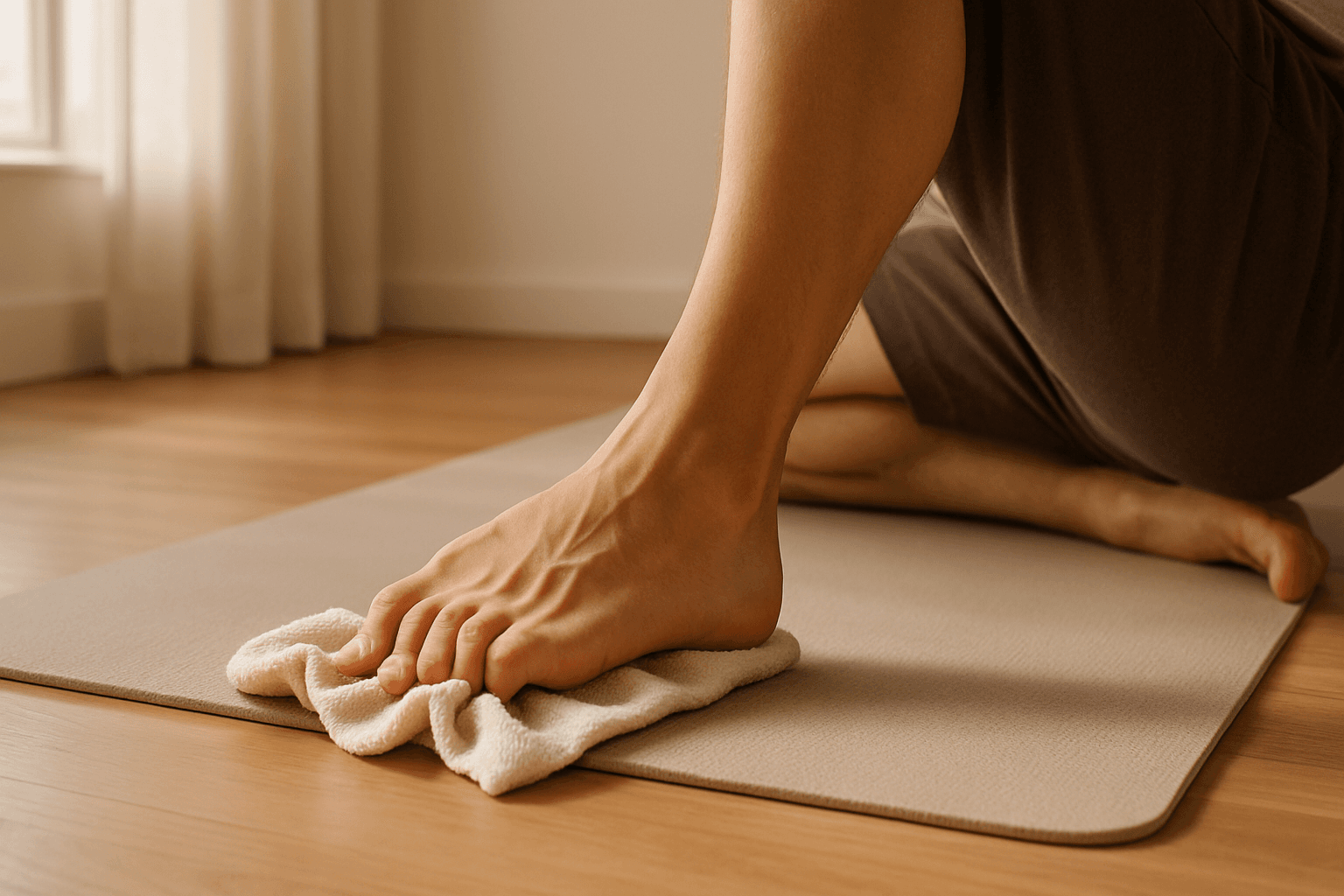
Stretching the calves and fascia calms plantar fasciitis for a while; exercise is what keeps it calm. The small muscles inside the foot, the calves, and the muscles that control the hip and knee are the team that decides how much of every step the fascia has to absorb. When that team is weak, the fascia does the extra work — and when the fascia is already inflamed, the extra work is exactly what keeps it inflamed. A short daily routine of low-load exercises rebuilds the team over a few weeks so the fascia can finally recover.
This is not gym-hero work. The whole session is under ten minutes and uses a towel, a step, and a wall. It is meant to slot in alongside the stretching in our plantar fasciitis stretches routine, not replace it. Do the stretches first, then the exercises below, then get on with your day.
As with everything on this hub, exercise is a support-and-relief tool, not a cure. Persistent heel pain that has not eased after four to six weeks of honest home care, or pain that came with an injury, swelling or numbness, deserves an in-person exam by a doctor or podiatrist. If you are still deciding whether your pain matches plantar fasciitis at all, our why does my heel hurt map is a better first stop than this page.
Why exercises matter as much as stretching
The plantar fascia is one small part of a big system. The intrinsic muscles inside the foot — the tiny ones between the arch and the toes — help hold the arch's shape. The calves control how much load reaches the heel with every push-off. The glutes and hip muscles decide whether the knee stays over the foot or drifts inward, which changes how the foot lands. Weakness anywhere in that chain hands more work to the fascia. Stretching alone can only take you so far when the muscles that were supposed to share the load are not showing up.
The exercises below are all low-load on purpose. Plantar fasciitis is an irritable, overloaded tissue; the goal is to strengthen the supporting cast without piling more force onto the fascia itself. In practice that means slow tempos, small ranges of motion at first, and stopping short of sharp heel pain. You should feel muscles working, not the sore heel throbbing.
Towel scrunches for the small foot muscles
Sit in a chair with a small hand towel on a smooth floor and bare feet. Put the sore foot on the near edge of the towel. Use only your toes to scrunch the towel toward you a few inches, then push it back out. Two to three minutes per foot, once a day. Add a light book on the far end of the towel for resistance once it feels easy.
This wakes up the abductor hallucis, flexor digitorum brevis and the other intrinsic muscles that share arch-support duty with the fascia. They are usually weak in anyone with plantar fasciitis, partly because supportive shoes have done their job for years and partly because sore feet quietly stop using them. Two to three weeks of daily scrunches make a surprising difference in how the arch holds up at the end of a long shift.
Short-foot drill (the arch dome)
Sit or stand with both feet flat. Without curling the toes, try to draw the ball of the foot back toward the heel — as if you were shortening the foot from front to back. The arch should lift slightly into a small dome. Hold for five seconds, relax, and repeat ten times per foot.
This is the intrinsic-muscle exercise physical therapists teach when they want to isolate the small foot muscles without letting the long toe flexors take over. It feels strange the first few days; you may have to touch the arch with a fingertip to feel it lift. Once you have the feel, the drill is easy to do at a desk, in the car or while brushing your teeth. Three sets of ten per foot, once a day, no equipment.
Heel raises: double leg, then single leg
Stand next to a counter or wall for balance. With both feet flat and hip-width apart, slowly rise onto the balls of the feet, hold at the top for two seconds, then lower over three seconds. Ten to fifteen repetitions. When two-legged raises feel easy, progress to standing on the sore leg only, using the counter for balance, and doing eight to twelve slow single-leg raises. Add a set of the same movement with the toes on a book or a small block so the heel drops slightly lower — this loads the whole calf-Achilles-fascia complex in a controlled way.
Heel raises look like a calf exercise, and they are, but the slow lowering also loads the fascia the way running and walking do — controllably, at a tempo you choose. Building calf strength is one of the most reliable predictors of recovery in stubborn cases, because a strong calf takes tension off the Achilles, which takes tension off the fascia. Stop the set if the heel starts to hurt sharply; a firm working sensation in the calf is what you want.
Eccentric step-downs for the calf and Achilles
Stand on the edge of a stair with the balls of both feet on the step, heels hanging off, holding the railing. Rise up on both feet, then shift your weight to the sore leg and slowly lower that heel below the step over three to four seconds. Use the good leg to help you rise back up. Eight to ten controlled lowers, once a day.
The slow-lower half of the movement is what does the useful work. Eccentric loading of the calf and Achilles has good evidence behind it for Achilles tendinopathy and pairs well with plantar fasciitis rehab because the two problems share a mechanism. If a full drop below the step is too much at first, do a half drop and progress over a week. Never bounce.
Wall sit with a mini-band around the knees
Slide down a wall until your knees are bent about sixty degrees, feet hip-width apart. Wrap a light resistance band around your knees just above the kneecap and push the knees gently outward against the band. Hold thirty to forty-five seconds. Three rounds.
This is a hip and glute exercise, not a foot one, and that is the point. Weak hip abductors let the knee collapse inward when you walk, which rolls the foot inward and stretches the fascia further with every step. A minute of glute activation a day is a small investment for a real change in how the foot lands.
How to fit it into a real week
Morning: five-minute stretching routine (towel stretch in bed, wall calf stretch, seated fascia stretch). Evening: five-minute exercise routine (short-foot drill, heel raises, either the step-downs or the wall sit, plus towel scrunches while you watch TV). Rotate the two loading exercises — step-downs one day, wall sit the next — so nothing gets overworked. Skip a day if your heel is more sore than usual; two easy days is better than pushing through a flare.
Give the routine three to four weeks before deciding whether it is working. Pair it with a supportive shoe or the Akusoli insoles we recommend first, because you cannot out-exercise an unsupportive shoe that is re-loading the fascia all day. The broader picture — what plantar fasciitis is, what triggers it, and how to tell it apart from look-alikes — lives on the plantar fasciitis hub.
Add the support that makes the routine stick
A firm arch and deep heel cup pair naturally with a daily exercise routine — here's the trim-to-fit pair we recommend first.
Add the support that makes the routine stick →Frequently asked questions
Can I exercise if my plantar fasciitis is still painful?
Yes, provided the exercises are the low-load kind on this page and you stop short of sharp heel pain. A firm working sensation in the muscle is fine; a stab under the heel is a sign to reduce range, slow the tempo or take a rest day. The bigger risk is the activity that flared it — a mileage spike, long shifts on concrete, barefoot floors — which usually needs a temporary cut regardless.
How long until exercises make a real difference?
Most people feel a small change in arch fatigue and end-of-day soreness within two to three weeks of a daily routine. Real strength changes take six to eight weeks. If nothing has moved after a month of consistent practice paired with stretching and a supportive shoe, add an insole or see a clinician for a hands-on assessment.
Should I do these exercises barefoot?
The intrinsic-foot exercises (towel scrunches, short-foot drill) are done barefoot — that is how the small muscles learn to work. The loading exercises (heel raises, step-downs) can be done barefoot on a soft surface or in supportive shoes; if the sore heel objects to barefoot loading, wear the shoes.
Are these exercises safe if I also have Achilles pain?
The eccentric step-downs are actually a standard Achilles rehab exercise, so they can help both. Skip aggressive stretching in the acute phase of Achilles pain and let the heel raises and step-downs do the loading work instead. If the back-of-heel pain is severe, see our why does my heel hurt map to sort out which pattern is dominant before diving in.
Do I still need to stretch if I do these exercises?
Yes. Stretching lengthens the calf and fascia so the tissue is not chronically pretensioned; exercises build the muscles that share the load. They solve different halves of the problem. The morning towel stretch alone is worth more than any single exercise on this page, so do not drop it.
When should I see a doctor rather than add more exercises?
See a clinician if home care has not moved the needle after four to six weeks, if the pain is severe enough to change how you walk, if there is swelling, numbness, tingling or a color change, or if the pain followed a specific fall or injury. Persistent heel pain in a child or teenager is a different problem entirely and always deserves an in-person exam.
HeelCups is reader-supported. When you buy through links on our site we may earn an affiliate commission, at no extra cost to you. This article is general information about foot comfort and is not medical advice — see our medical disclaimer.