ACHILLES TEST
The Thompson Test: How Clinicians Check for a Ruptured Achilles and Why You Should Not Rely on Doing It Yourself
The calf squeeze (Thompson) test is a quick bedside check for a complete Achilles tear. Here is how it works, what a positive result looks like and why a self-check is no substitute for an exam.
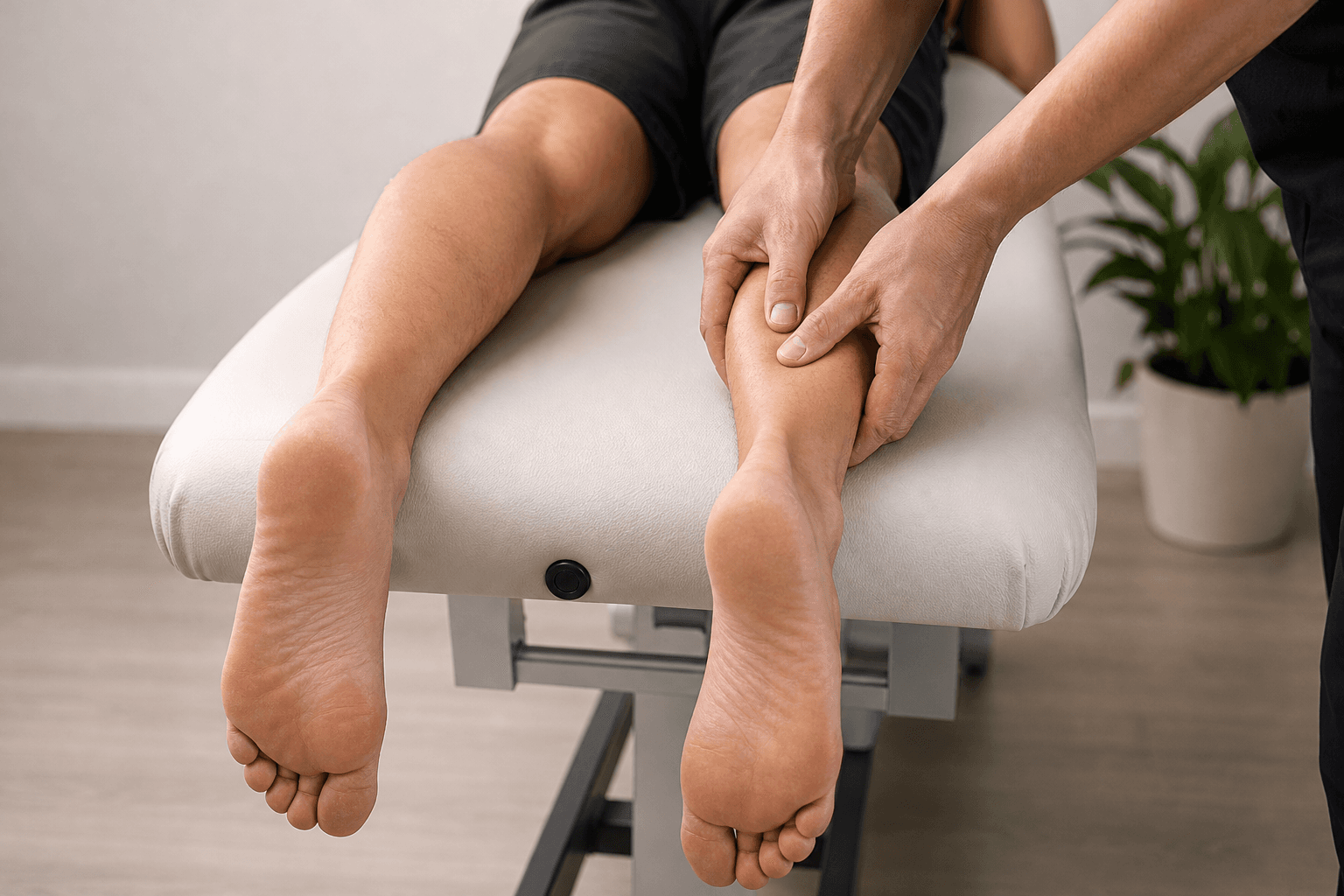
The Thompson test, also called the calf squeeze or Simmonds test, is the standard quick exam for a completely torn Achilles tendon. A clinician squeezes the calf while you lie face down, and a healthy tendon pulls the foot downward like a pedal. If the foot does not move, the tendon is likely no longer connected to the calf muscle. Cleveland Clinic describes it as a simple, painless test that takes seconds.
Published figures put the test at roughly 96 percent sensitivity and 93 percent specificity, numbers reported in a 2013 meta-analysis by Wang and colleagues and often traced back to earlier work by Maffulli. That makes it a strong screening tool for a full rupture, but it is not perfect, and it is much less reliable for partial tears. Treat those numbers as the performance of a trained examiner, not of a quick self-check at home.
This page explains the method so you understand what a clinician is looking for. If you felt a pop or snap at the back of the ankle, cannot rise onto your toes, or see a gap in the tendon, skip the experiment and get same-day medical care. Our guide to the signs of an Achilles rupture lists the other red flags.
How the test is done
You kneel on a chair or lie face down on an exam table with your feet hanging free over the edge, so the calf muscles are relaxed. The examiner squeezes the thickest part of the calf, about a hand's width below the knee, firmly but not painfully. Physiopedia and Cleveland Clinic both describe the same sequence: squeeze, then watch the foot.
In an intact tendon the squeeze tugs on the tendon and the foot flexes downward a little, toward the floor. Most examiners compare the injured side with the healthy one, because natural movement varies from person to person.
What a positive result looks like
A positive test means the foot does not move, or moves much less than on the other side. That pattern suggests a complete rupture, because the squeeze can no longer transmit force through the tendon to the heel bone.
A negative test, where the foot moves normally, makes a full tear unlikely. It does not rule out a partial tear or a tendon that is simply irritated, which is covered in our guide to Achilles injury types.
Why self-testing is unreliable
Several things make the test harder than it looks. Swelling and pain can cause you to tense the leg and mask or mimic movement. Other tendons at the ankle can move the foot slightly even when the Achilles is torn, which is one reason a trained examiner watches carefully for a small flicker of motion. And you cannot squeeze your own calf in the relaxed, hanging position the test needs.
False reassurance is the bigger risk. A tear that is missed in the first days can end up with a longer, looser tendon and a weaker push-off, so a result that seems fine at home should not stop you from being examined if the symptoms fit.
What else the clinician checks
The Thompson test rarely stands alone. Clinicians also feel along the tendon for a gap, check whether you can rise onto your toes on the injured leg, and compare how the resting foot hangs. In the Matles test the knee is bent while you lie face down, and a foot that droops less than the other side points toward a tear.
If the picture is unclear, ultrasound or MRI can show how much of the tendon is torn. That helps decide between boot-based and surgical care, which our guide to torn Achilles recovery time walks through.
If you cannot get seen the same day
While you arrange care, keep weight off the leg as far as you can, avoid stretching the calf, and use a crutch or support if one is available. Raising the foot when resting can keep swelling down. Do not massage the area or push through pain to test whether it still works.
Pain that is gradual, stiff in the morning and sore along the tendon is a different story. That pattern is more often tendon irritation, and the Achilles tendonitis page covers what eases it. Either way, tell the clinician exactly when and how the symptoms started.
Back to the heel pain hub
Map your pain by location and timing, and see which pages match.
Back to the heel pain hubFrequently asked questions
What is a positive Thompson test?
A positive test means the foot does not flex downward when the calf is squeezed, or flexes much less than on the other side. It points toward a complete Achilles rupture and should lead to prompt medical care.
How accurate is the Thompson test?
A 2013 meta-analysis reported about 96 percent sensitivity and 93 percent specificity for complete ruptures when performed by a trained examiner. It is less dependable for partial tears, so a clinician may add other tests or imaging.
Can I do the Thompson test on myself?
It is hard to do reliably because you cannot relax the calf and squeeze it at the same time, and swelling or pain can confuse the result. If you suspect a tear, get examined instead of relying on a home check.
Does a normal result mean my Achilles is fine?
Not necessarily. A normal result makes a complete tear unlikely, but a partial tear or tendon irritation can still cause pain and may need a plan from a clinician.
Is the Thompson test painful?
The squeeze is brief and usually only uncomfortable. If the area is already sore, tell the examiner so the pressure can be adjusted.
HeelCups is reader-supported. When you buy through links on our site we may earn an affiliate commission, at no extra cost to you. This article is general information about foot comfort and is not medical advice — see our medical disclaimer.